[This is part 2 of a longer series – previous post “Interlude” – previous track – “Introduction” – next track – “Definition”]
That’s what hip-hop is: It’s sociology and English put to a beat, you know.
Talib Kweli
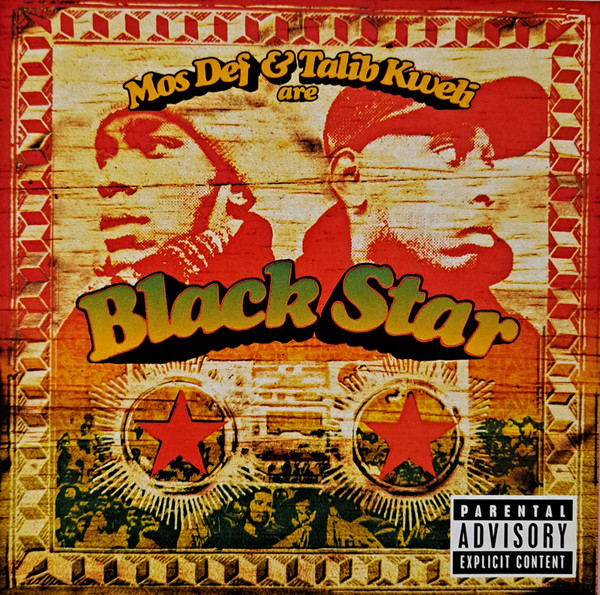
Now fast forward to post-post-pandemic 2023, and Malachi, a student (all the names are changed) exasperated, looks at me after listening to Mos Def and Talib Kweli are Black Star for the first time and says “this whole album is just chill beats where they try to cram a whole essay into each song.” He was offering this as a criticism. And he’s not wrong. Kweli admits as much in his memoir – conceding that some critics bemoan his insistence on over-saturating lines with content, breaking the rhythm. I guess it’s not surprising both Mos Def and Talib Kweli come from academic families.

If this album is an academic seminar – not a bad metaphor, considering the multitude of voices that end up speaking – then “Astronomy (8th Light)” – the first proper song on the album – poses its guiding question. It phrases it like Socrates does by asking “ti esti?” – “What is it?”. Here are the opening lines:
Against the canvas of the night
Appears a curious celestial phenomenon,
called Black Star – but what is it?
Black people unite, and let’s all get down
We got to have what? We got to have that love
“What is the Black Star” (as the song later asks)? We get a answer but only at an angle: “black people unite and let’s all get down” – they answer the question with a command. And then a call and response rhetorical question “we got to have what? We got to have that love.”
If this song is an essay within a larger project, then there’s its thesis. It answers an intellectual question about its a central motif by responding with a call to action – because like the MC said in the intro, “music ain’t supposed to stand still.” This is a deeply cerebral album, but it’s not just about thoughts – the black star is “intimate and distant” – it’s about thoughts, beliefs, feelings and ultimately actions.
The first verse continues in this line, and like a great folk tale, it never directly answers the question, but re-asks it in a series of generative ways. Here we get a taste for the album’s great orality – its compositional structure relies so much on the accretion of meaning through a kind of developed, seemingly improvised but very organized playfulness. This enters into the grand tradition of competitive storytelling that created texts like The Odyssey or the Ramayana. It’s sort of a truism that hip-hop is an oral tradition, but I think it’s worth delving into that a little.
Oral composition involves something that looks like memorization but is actually more like controlled improvisation. Most of the major rhetorical devices we analyze grow out of this – like anaphora – the repetition of a word or phrase at the start of successive clauses (“Black like…” in this song) lets a performing oral poet know how a line ought to start, and while that poet performs that repeated line, they grab a few vital milliseconds to invent the second half of the line. Similes can do the same thing, especially when they’re repeated. This appears all over the place in Black music – in the Blues, in the spirituals, a lot of which emerged from a period when literacy – and the act of writing – were illegal for their composers. But, human beings being what they are, in the absence of legally condoned literacy, oral composition strategies asserted themselves. And you can hear that in Mos Def’s voice in lyrical successions like this:
Black, my family thick like that-strap molasses
Star on the rise in the eyes of the masses
Black is the color of my true love’s hair
Stars are bright, shinin’, hot balls of air
Black like my baby girl’s stare
Black like the veil that the Muslimina wear
Black like the planet that they fear, why they scared?
Black like the slave ship belly that brought us here
Black like the cheeks that are roadways for tears
That leave black faces well traveled with years
Black like assassin cross-hairs
Blacker than my granddaddy armchair
He never had no time to chill there
Because his life was warfare
Now, obviously Mos Def and Talib Kweli know how to read and write, and they exemplify the vastness of that reading and writing on this album. But when they lay down lyrical passages like this, they’re playing an oral game. In the memoir, Kweli talks about competitive ciphers he was involved in in and around Washington Square Park, while he was briefly enrolled at NYU: you could get kicked out being found to have written your lyrics down.
In oral composition, the lines often cleave into halves – here, the first half – “Black like” – gives its performer a brief pause to conceive of a clever second half. I know when they recorded this they did multiple takes and so timing is really a little different, but I’m talking about the mode of composition. Here you can see the anaphora and rhyme working together, allowing the performer to shape their line mentally by drawing on memory patterns, narrowing down the wide range of words they might pick to a smaller number that fix the rhythm and/or the rhyme. “Black like the veil that the Muslimina wear” uses anaphora (“Black like…”), a simile (comparing the color and a piece of clothing), an Arabic word (“Muslimina”) and then the following line “Black like the planet that they fear, why they scared?” tosses in another allusion (to Public Enemy), and “scared” picks up the half-rhyme/assonance with “wear”/”scared.” I can’t say how these two lyricists created their lyrics, but it sure feels to me like they did it primarily with their voices, not their pens. Which also helps to explain the undeniably rhythmic dexterity so many moments exhibit – and the joy I hear in their voices, where many times, a briefly felt inflection can reveal a momentary prideful marveling at their own cleverness.
To me, a big part of the “movement” of the album – and its democratizing ethos – comes from its orality. This opening verse is a wonderful reminder of the power of that orality as a force of literary composition – and simultaneously as a force of political organization. Sebastian – one of the most introspective students I’ve ever had the privilege of working with, who was in that first group of pandemic remote learners, showed me that the “black like…” catalog functions as a re-definition (literally the name of a later song on the album), a re-claiming of a term that was originally devised as a tool of paralyzing racist social control. The catalog forcefully reinvests “Black” with a range of dynamic, empowering meanings.
But by time you get a hold of those, the flow takes the song to another level, as Talib Kweli subtly accelerates, throwing an joyfully endless cluster of cultural references (one of the most amazing parts of the album is the seeming effortlessness with which those allusions pile up) – starting “I love rockin’ tracks like John Coltrane love Naima” (both Coltrane’s wife’s nickname and an eponymous song), all exemplifying Black identity in less direct ways, as the song moves along to alternatives, including a clear and cleverly allusive call to action – “Black like a Panther/Revolution is the answer” but ultimately the answer to the song’s original question that stands out most to me is a seemingly simple one: “You know who else is a Black star? (who?) Me.” Mos Def and Talib Kweli confidently let their light shine in the darkness.
[This is part 2 of a longer series – previous post “Interlude” – previous track – “Introduction” – next track – “Definition”]

 Original Positions
5 thoughts on “Astronomy (8th Light) (track 2)”