
The “is a video game literature?” argument is interesting and I do appreciate reasoning about it – but also, I think we can gain some interesting perspective on real academics at real college institutions – and reputable ones too – who have already settled the argument in their own heads and explored what it would mean to treat video games as literature. Video games are a huge aspect of culture and so they’re being studied rigorously and creatively. I think we can learn from it if we want to, and so can our students.
In this post I too am going to try my best to move past the debate and explain how I went about including video games in my AP Lit class this year. I focused it mostly around developing the skills needed for the AP English Literature and Composition Exam’s Question 2 – the so-called “prose” question. Which in some ways has a lot in common with the poetry question – both centering close reading and writerly craft, as opposed to broader thematic and argumentative aspects of literary criticism.
Group Play – Background Knowledge from Childhood
At the February 2026 IDEACon (Illinois Digital Education Alliance Conference), I stayed after Matthew Farber’s excellent presentation about his book The Well-Read Game. Earlier, he had said something like “look, you’re not going to get a whole class playing a video game and analyzing it, it’s just not going to happen, but some things you can do are…” I stayed after to ask him “why not?”
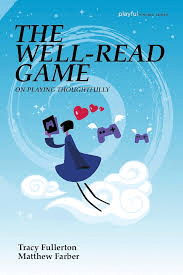
He replied that what I was proposing was institutionally unrealistic for a lot of people, but that if that wasn’t true for me, he would recommend that I put students in groups and have them play not in isolation but in dialogue. Which sounded great to me. It also tied in with a lot of formative social memories of my own – I remember playing while my little brothers watched, or watching my friends play at their houses, and talking the whole time. After I got into the unit, I asked my students if they too had those experiences, and of course they did! Something else I remember doing – playing Doom with my friend one on one via dialup, just possible for a relatively affluent kid to do in 1993. Today’s gamers have this experience in spades on the internet (even if this is sometimes problematic and unsafe). Considering all of this I decided to have my students play in dyads, and so made it a central aspect of my planning. Because someone watching has actually been doing something else – they’ve been interpreting and analyzing. And often developing a skill they may not have verbalized (especially if their older sibling wasn’t interested). If a book group is a natural unit of book-reading analysis, a dyad (or triad) wherein one is playing and the others are watching may just be a natural unit of video-game analysis.
I had them pick partners, and use what I’ve come to think of as the pilot/co-pilot relationship to help them build meaning.
Gaming and Oral Composition – Background Knowledge from within my course
Much earlier in the year, students did some focused study of Beowulf, and while doing that, they played Dungeons and Dragons (I also wrote a set of posts about that experience). The basic idea was for them to see how the oral-poetic aspect of Beowulf was a cultural universal, which included excurses into watching the 2025 film Sinners (which names the universal in its opening monologue), as well as talking about the Homeric Question, multiple authorship, and oral composition. But beyond all that, students also became intuitively familiar with the literary aspects of gaming. We didn’t theorize very much of that beyond to say that different characters’ point of view could produce strikingly different narratives of the same situation. Students role-played on groups and then wrote those perspectives into existence, and then analyzed them in more of a Q3 way – looking at how the big picture stories emphasized different themes depending on who was narrating.
I spent some time talking with one of our instructional coaches who specializes in technology integration, and we brainstormed ways we could approach this task. She was able to connect with me with the E-Sports coach, and the three of us had a wide-ranging conversation. We figured out what was doable and what wasn’t. And I’ll say, this was a little tough for me – as a gamer who’s always liked trying to get hardware to things a little beyond what it’s able to do, I was somewhat impatient with their realism, but ultimately, we worked things out.
Dungeons and Dragons, if you don’t know, is a low-tech game. In my classroom it was played with photocopies, notepads, dice and pencils. Video games, of course, are high-tech, sometimes prohibitively so. My initial dream had been to build a unit that would be a kind of capstone/full circle moment – rather than playing low-tech D&D, they’d be playing a very high-tech Baldur’s Gate 3 (2023), the highly critically acclaimed implementation of the D&D 5th Edition Rules set into a video gaming context, with A-list voice actors and CGI creating a wide array of very gender and racially diverse fantasy characters, a branching plotline and moral complexity so deep that comparing it to the Homeric multi-text in Gregory Nagy’s sense is not so much of a reach.
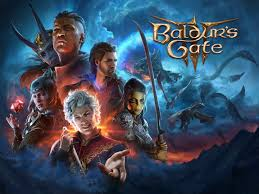
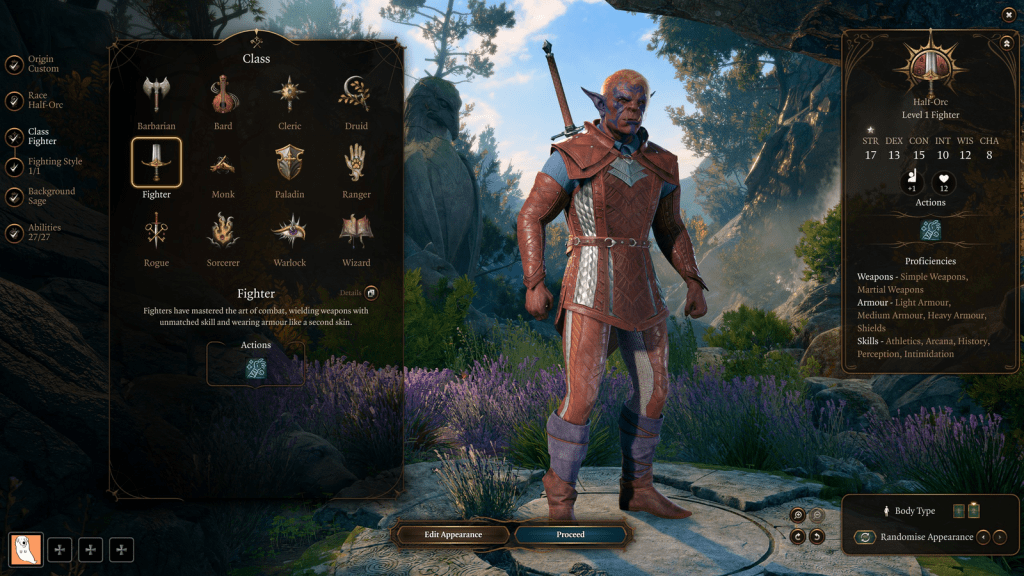
It also costs $60 for a single licence, and requires some extensive hardware – a PS5 ($600+) or an up-to-date gaming PC (likely $1000+). Fortunately, my school does have an “ESports Club” that has 15 reasonably up-to-date gaming PCs that the activity’s sponsor was generous enough to let my students use. My thinking was this: have a class of 24 kids work in pairs of two, hopefully echoing their childhood play experiences. Each of 12 pairs would play their own game. I was thinking that given the way the game’s character and plot system works, they would sincerely have generated 12 very different games, even just playing the first few hours of the game. We could have then done a bunch of interesting comparison-contrast work. This was going to culminate in students creating a short video of their first 15 minutes of narrated play-along and then trading videos with other pairs, who would analyze that 15 minute video in a Q2 type essay. They’d have lots of axes to work along (more on that below), but a core focus would have been player interaction and how it built character. I think their minds would have been blown with how divergent these storylines would have become even in 15 minutes.
But still wanting to conform to copyright laws, I was looking at $720, and a really long install time. I started installing on one PC about a week before the unit was to start, and it looked like it was going to take 1.5 hours to install from a flash drive. I say “looked like” because while that was happening, a student who was helping me accidentally tripped on a power strip and it shut down. I took this as a sign of “this is not meant to be.”
So I pivoted to another game – the 2019 Disco Elysium, which I hadn’t played very much, but which is also very highly critically acclaimed- on one recent list, Baldur’s Gate 3 is #1, and Disco Elysium #2, for greatest PC games of all time. It was also much smaller as a download, and was recently on sale for $5. $60 I could stomach much more than $720, so that’s all I needed. Well, sort of. The gaming PC’s all had tiny speakers but were mostly designed to be operated with headsets, though the members of the E-Sports club generally brought their own. I found a box of 25 headsets for $30 on Amazon, and my Tech department had some ⅛” splitters to allow two students to plug in at once. So for roughly $100 of my own money, I was ready to go. I viewed it basically like buying a set of paperbacks for my classroom, something I think a lot of people reading this have probably done. The installation took about 10 minutes per PC, which was much more manageable, so one afternoon, I took care of that.
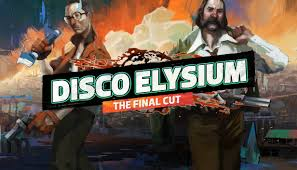
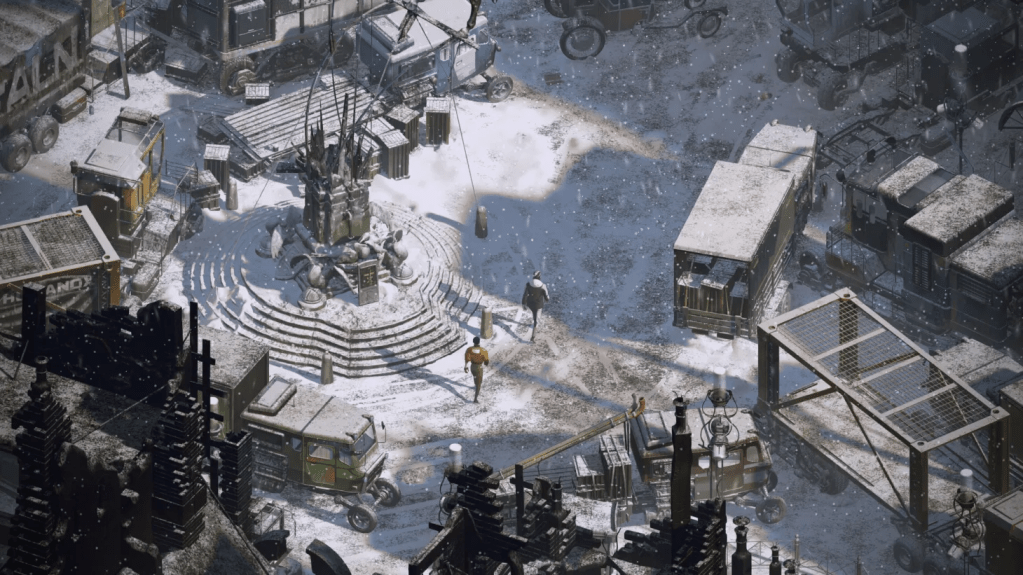
The next week, I started the unit. What I’ve listed here is a rough breakdown of how I used the time over 8 days.
Day 1 – 60 minutes – Framework discussion, initial gameplay and troubleshooting
I began the first day of the unit with a Socratic kind of discussion – not a “Socratic Seminar” but a discussion of a Socratic “ti esti?” (“what is it?”) question – “what is literature?” We talked through definitions that would include or exclude books, films, television shows, epics built in oral traditions, video games, etc. Some students were intuitively more interested in a broader definition than others. Which I thought was interesting. I tried my best to keep my opinions out of it but also just get them to sincerely explore what these different media have in common or don’t.
That same day during the second half of the block, for about 45 minutes we went to the E-Sports lab. I gave them no other instructions than to get used to the headphone set-up, plug in the keyboards as mice (which the E Sports club keeps locked up – a mild frustration I just had to live with), and get playing the game. I did not want to overscaffold. They ended up with about 30 minutes of play time after getting the setup working and picking partners.
Disco Elyisum is – at least to me – genuinely strange. It’s called a “narrative heavy” game – lots of text on the screen at any given time, and with the final edition of the game, it’s almost all voice narrated. The game itself was created by Estonian author Robert Kurvitz – a novelist who had toyed with the idea of integrating role-playing game content into a novel. Interestingly, he also worked with “mass editing” as a way of finishing his earlier novel Sacred and Terrible Air (which has been voluntarily “mass translated” into English also)- essentially beta testing it over a crowd of people like a video game, and also somewhat like the way oral literature like Beowulf was transmitted. In my head this game unit was taking the place of a late 20th century fiction unit that dealt a lot with memory and time sequencing. We’d watch Memento and then also read books like Beloved, Wandering Stars, If Beale Street Could Talk, Woman Warrior, One Flew Over the Cuckoo’s Nest or Slaughterhouse 5.
I didn’t tell them any of that – I just let them play.
The game opens with character selection – 3 preset “archetypes” (see – literature!) and one “Build your own.” Each of them picked differently – roughly evenly among to presets and the build your own. Some of them got really into building their own, talking through how the systems seemed to work, and what types of personality types were like them, or what would be fun to play, and so on. I wish I had video recording going on at that moment but I didn’t. It would be fascinating to study in itself.
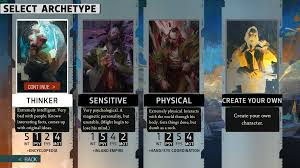
Eventually they began the actual game play which involves waiting up from out of a drunken amnesiac stupor. Here’s a good place to explain that this game has some “mature content” but much more in a Shakespearean sense than explicit nudity or violence. Direct acts of violence in this game are actually much rarer than most games (than baldurs gate certainly). There is a good deal of explicit R-rated language. These students being close to the end of their senior year, I thought were okay with it. Some of it (for example the f-slur) yielded interesting discussion afterwards.
Once the character talks with their own inner demons for some time, they wake up. In a room. Players begin to decide what they can and can’t control. A big part of the game mechanics involve internal aspects of yourself talking to you – they’re personified on the screen with graphic-novel surrealist art icons- traits called things like “interactivity” or “savoir fare.” They talk TO you, where “you” is some other part of you, maybe your “central processing unit” – it’s like a postmodern, cynical and at times crass version of Inside Out. It’s not clear how many “parts” of you there are, or how much control you have over them.
Objects “in” the game’s world also talk to you- mirrors, light switches, doors, electronics equipment. You’re initially in a room where you find some clothes (presumably yours) and figure out how to leave the room. You never know if that’s because you’re hung over and/or suffering from delirium tremens, or if it’s the surreal game world, or both. A lot is determined by on screen dice rolls that depend on your characters’ stats – so this is a role playing game like D&D in some sense.
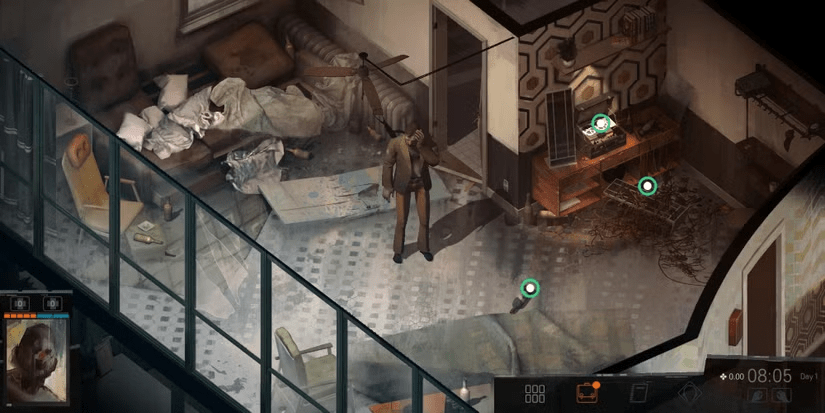
By the end of the first day most of them had gotten out of that room and begun to explore the broader building and city.
Day 2 – 45 minutes. Experiential Reading of Disco Elysium (One partner playing, one co-piloting and annotating)
First, I led a brief discussion about these two diagrams from Farber’s book.
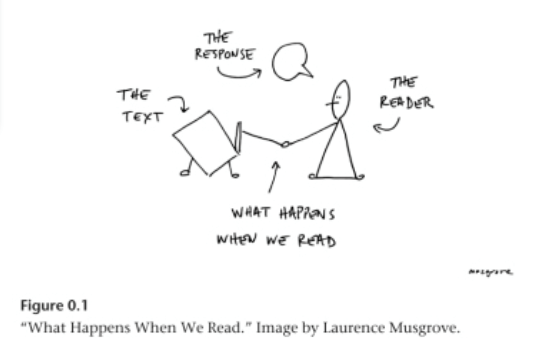
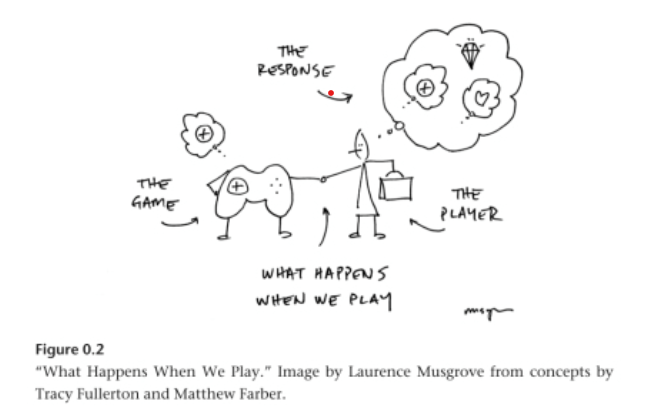
I asked them to compare and contrast the two diagrams just to get their minds going.
It was an interesting if brief discussion. A lot of it focused on the controller having legs, and the handshakes and what they might mean. Also the briefcase – which Farber explains as “baggage” that someone brings TO the game. The thought bubble about the controller was a source of interest too – what does that mean cs th more understandable one above the reader/payer?
After they sat down in the lab I also gave them this handout from Farber’s book (below is a little bit of it – it’s got 6 questions total):.
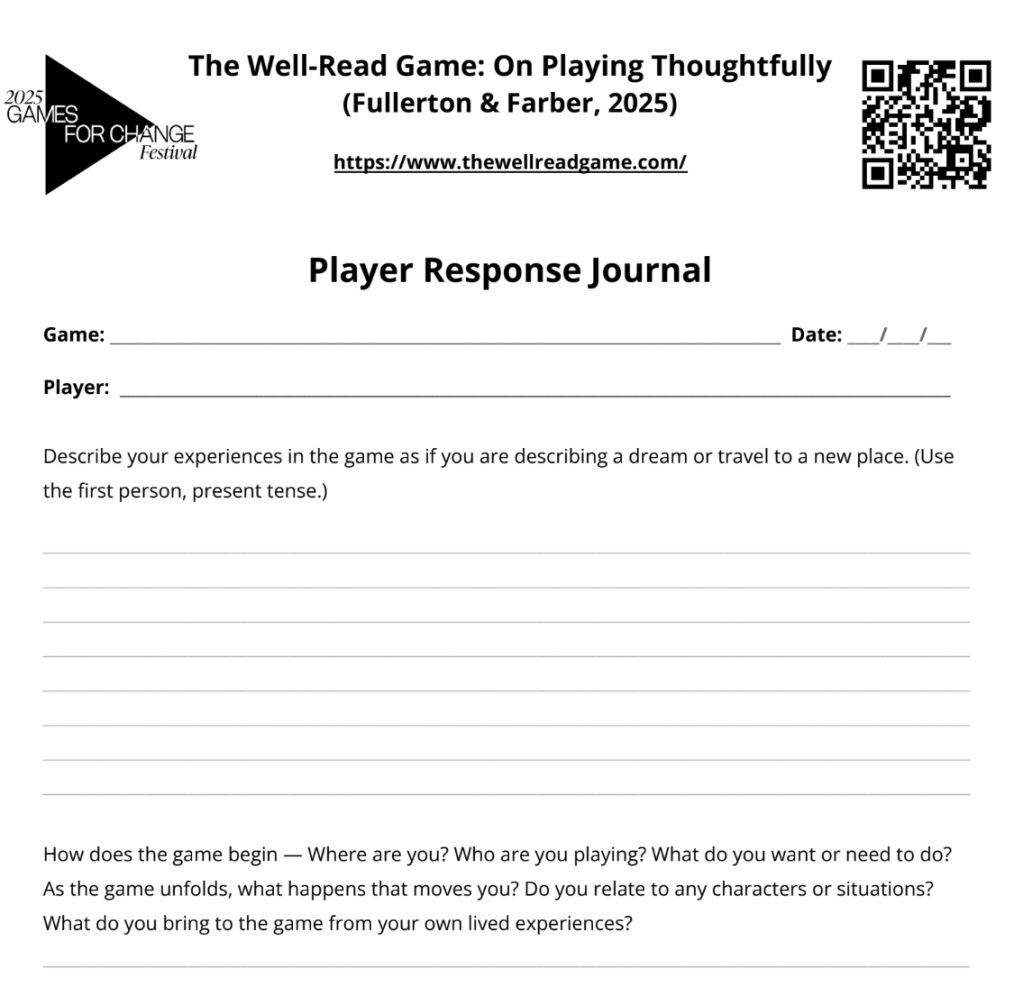
Since they were in pairs I invited them to do this with one person playing and one observing. To be honest it was pretty overwhelming trying to keep up with twelve groups playing. They were all (except one) deeply engaged. They were laughing, taking screenshots, puzzling, getting frustrated, curious – during this day some of their characters started dying too. The game’s mechanics are pretty unforgiving, and when you die, you get a screen like this:
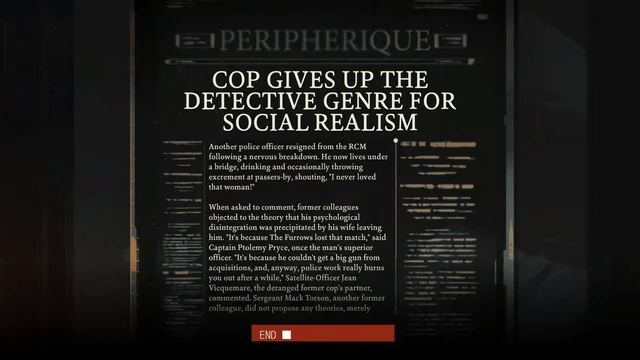
It’s subtle enough that some of them didn’t even know it meant they had “tied” or that it was even about them. And that headline itself is pretty interesting to “close read” in itself. It’s got a kind of Mobius Strip/MC Escher quality if you think about it.
Day 3 – 45 minutes. Experiential Reading of Disco Elysium – Partners Swap Roles
On day 3 I encouraged them to do the same thing as day 2, but changing roles- with fresh copies of the worksheet. Reading over the results was truly interesting in the variety of what they wrote about. Some were largely about the mechanics, frustration about not knowing what they were supposed to be doing, amusement by the vulgarity, reactions to thematically significant moments about identity, race, gender. On this day, I had a couple of conversations with players when I noticed potentially challenging or problematic sequences arose. For example- near the start of the game, a character says “f****t” several times. A student of mine who is queer reacted to this moment. I sat down and had a conversation and asked them about the impact. They said something along the lines of “they are using the word, but it’s pretty clear the game doesn’t want us to like that character.” Another student who was serving as copilot on this day (this was a Latina student), on her worksheet, wrote down how exciting it was to her that her player (who was white) had selected a dialogue choice that involved calling out an NPC (non-player character) for using racist language. But of these moments reminded me that students are much ore adept at reading tone and discerning authorial intent when race and gender charged moments arise than some of our efforts to “protect” them from that kind of language might imply.
Day 4 and 5 – 45 minutes each – this was another pair of days where they did the same thing twice but with one playing and one observing and analyzing
For these days I made my own worksheet, which I wanted to emphasize more of a Q2 type analysis — what techniques contribute to what “complex experience of” what. I based it loosely on the released AP Stable wording guidelines, which tend to use the phrase “complex experience of” in the final sentence of the prompt.
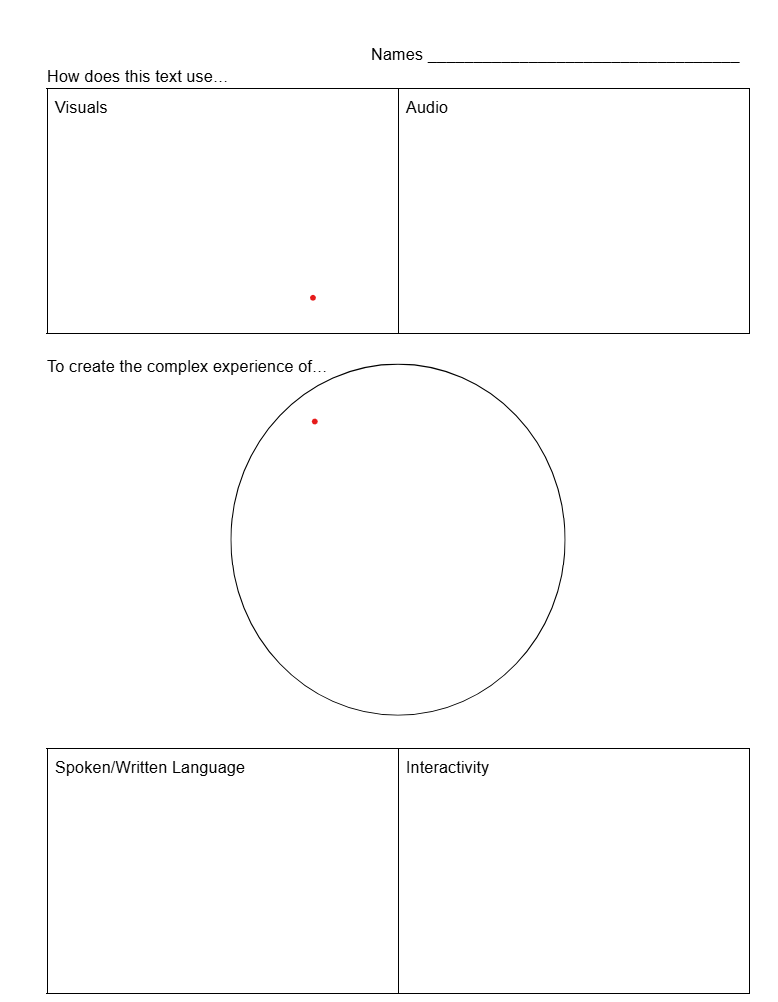
I intended a very simple graphic organizer – the outside boxes are for unfiltered observations that seem to fall under those categories – though I emphasized there are no hard and fast rules determining what qualifies for each box. The inside circle is meant to describe the intended or received effect upon the gamer, vis-a-vis some prompt. I didn’t specify a prompt on the first day they used this. I just asked them to write about the quality of the experience of them as a player, and also the quality of the experience of the character as it seemed intended to land.
I have a vision of making another version of this that, rather than prioritizing technique, would encourage them to think in terms of frames like beginning-middle-end. But with gaming, unlike with a book or even a page of prose, you don’t know what is the beginning, middle or the end until you’ve finished with the experience at least once.
I think this organizer made them see the gameplay differently, and play differently than when they were just playing, or using Farber’s worksheet. Not better or worse, just different. For what it’s worth, Farber suggests that this kind of technical/mechanical analysis is too common in video game studies. I haven’t read enough to know whether he’s right but I’m willing to believe him. I didn’t want to center it too much, necessarily, but I did want to help them develop a skill that was relatively homologous with the one they’d be tested on in with Question 2 of the Lit exam.
The results again were interesting – this kind of analysis comes pretty naturally to our students. Visuals and their impact on setting, audio and its affect on mood, interactivity and what it implies about a vision of human nature- they understood the categories and how they worked. It’s my belief that this previous knowledge is great because it allows them to see they know how to do this while avoiding plot summary. More on that below too. At moments like this, I realize we as teachers may be more like those older siblings that didn’t let them talk than we may realize. They’ve been watching videos and playing video games since they were very young. If we step back from lamenting this fact, and think about what they may have learned from the process, I think we can make real headway.
Day 6 – Writing Lesson with Retro-Gaming
We stopped going to the lab at this point – they had probably played the game for 2-3 hours, unless some of them snuck in during their lunch and played more (I have no idea, but I don’’t think so). The idea was now to transition towards a summative essay. I sensed that in spite of their intuitive awareness of visuals and audio and language and interactivity and the impacts they have, they needed some scaffolding around writing and making a cohesive argument.
To do that, I stepped back from Disco Elysium, which is a very complex game, back to the classic era of 80s gaming. The mechanics are simpler and in a lot of ways more legible and transparent – and, to be honest, these are also the games that made 10-year-old me love gaming. I went back to one of the first games I remember playing – the 1986 NES Metroid. Structurally similar to Disco Elysium in some ways – a lonely person in an incomprehensible world, figuring out who they are. Here it’s through the language of a side-scrolling action/adventure format.
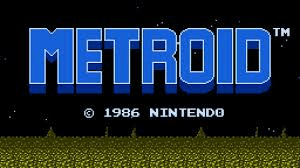
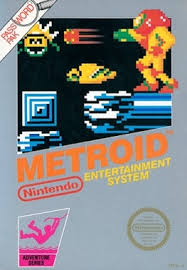
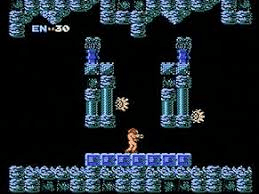
I played for about 15 minutes (you can play here) and gave them a copy of that worksheet, and posted this prompt on the overhead:.
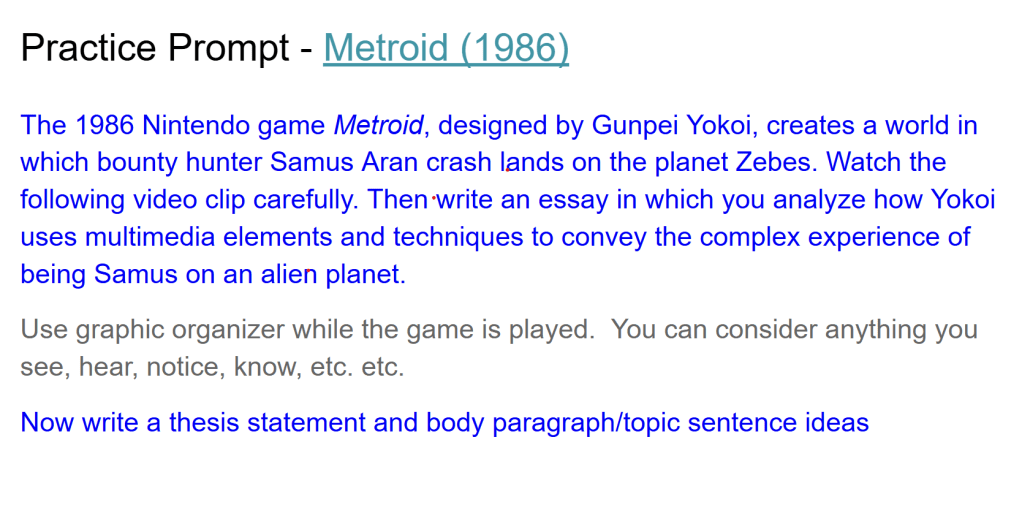
I tried my best to imitate AP Lit Question 2 – I think a crucial aspect of this was “designed by Gunpei Yokoi.” Of course, video games are designed by whole teams of developers, artists and testers, but I wanted them to consolidate their thinking around authorial moves, something I’ve noticed they often struggle with on “real” Q2s.
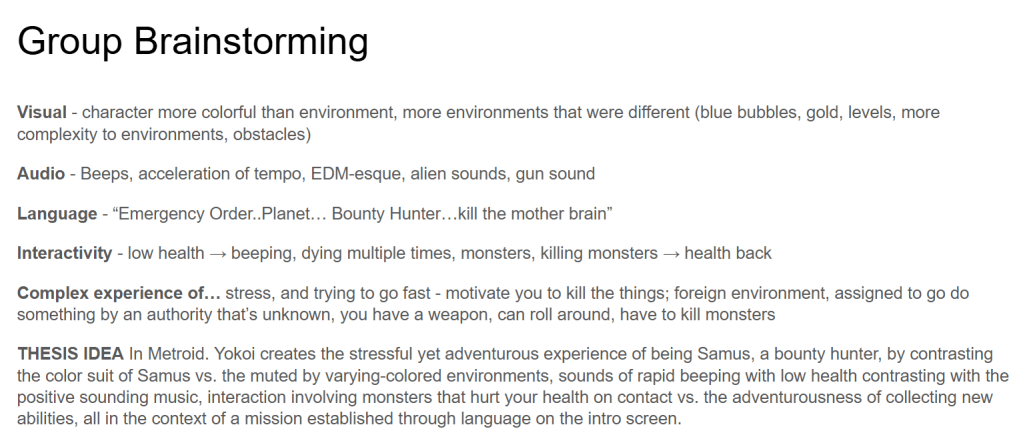
I narrated my playing to describe my reasoning (I wish and also don’t wish I had screen captured my narration to share with you). They came up with some good ideas to build a sense of complexity – a foreboding climate that encouraged adventure through self-improvement basically. They discovered analogous contrasts in the sound, video and interactivity aspects of the game, allowing the to build this thesis (I was taking notes on the overhead):
Day 7 – Writing Lesson with Retro-Gaming and a “Real” Q2 Prompt from 2024
The next day they’d be writing an essay about Disco Elysium. So this was the last chance to review. I decided for this day to work with another classic NES game – Kid Icarus. And since we’re in AP review season too I wanted to show them some portability between this and the actual Q2 on the exam. So I paired Kid Icarus (again, you can play here), a game with a winged mythological protagonist. With the 2024 AP Prompt from the magical realist book The Rockeaters (with protagonists who have wings and can fly).

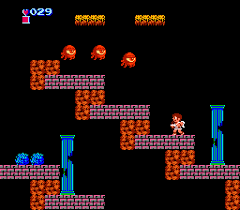
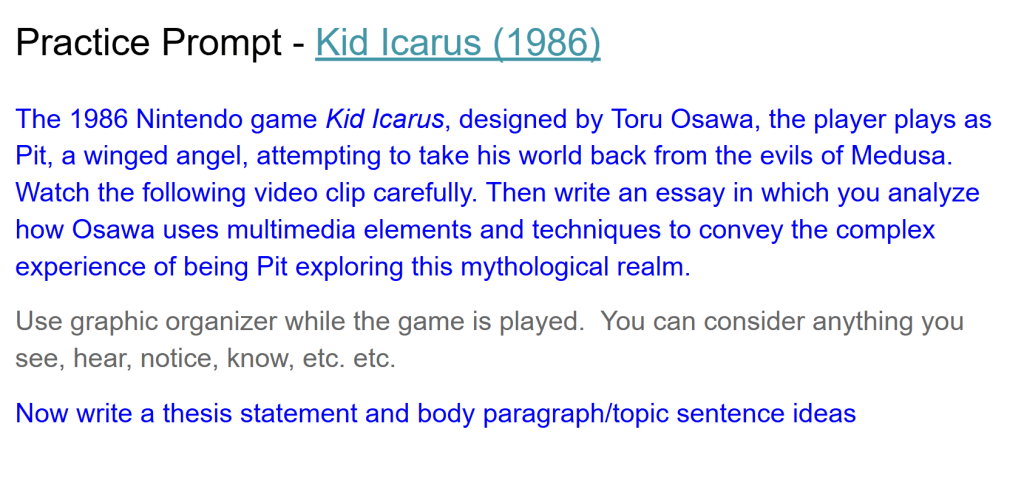
Instead of playing and narrating again myself, this time I took volunteers. Two girls volunteered – this felt important actually because through this whole unit, I had been mindfully monitoring how gender impacted the dynamic. Video gaming is notoriously a space for toxic masculinity, and I was worried that the girls might feel some of this, and/or the boys would get dominant. This isn’t usually what happens in my Lit class – it’s majority girls, and most of the boys are socialized to “not like reading” (which is its own kind of dominance assertion sometimes). But two girls who have been good friends since kindergarten (when, I imagine, they played video games together).
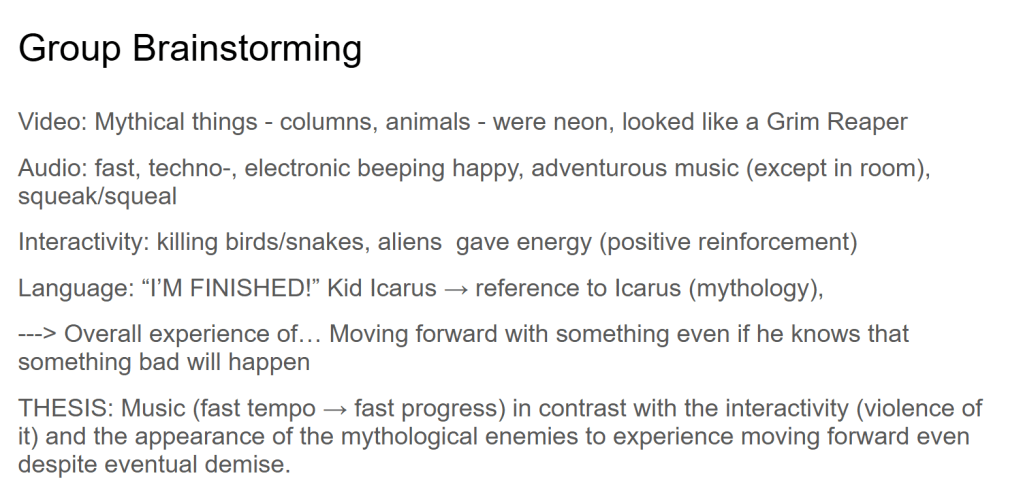
They did a good job of getting up there and narrating, playing while also being playful about it. It gave their classmates some good ideas for what to notice and I realize now that that kind of narration is pro-analysis. It’s a verbal version of annotating. It’s a great practice to build in other ways, and one that’s likely easier with a non-verbal medium like gaming than it would be with a novel ,where you’d have to continually interrupt yourself while reading. Now, that is something I do sometimes and it has some utility but in this context, it felt so much more natural that a kid with only seeing one example (me) doing it two days ago, was able to jump right in.
This time the brainstorming session with the sheet led to an interesting conversation about allusions (Icarus, Cupid, the grim reaper, classical columns, snakes, Medusa). And again they constructed a thesis:
For the last 15 minutes of class, I had them read and annotate the Rockeaters prompt, and encouraged them to build similar categories to visual/audio/interactivity/language. Of course with the AP prompt it’s all “language” and since earlier in the year, they had done with with these types of prompts though more traditional analytical categories – diction, syntax, figurative language, allusion – they used a lot of that, and said they saw the connections I was trying to get them to make (this was a rushed lesson though, I’m not fully sure about how it landed).
A thought for the future – I should build a more intentional connection between those two sets of categories. “How to read literature like a video game” would be the lesson title.
Day 8 – Summative Assessment (55 minutes)
On the 8th day of the unit. They wrote an essay in response to this prompt:
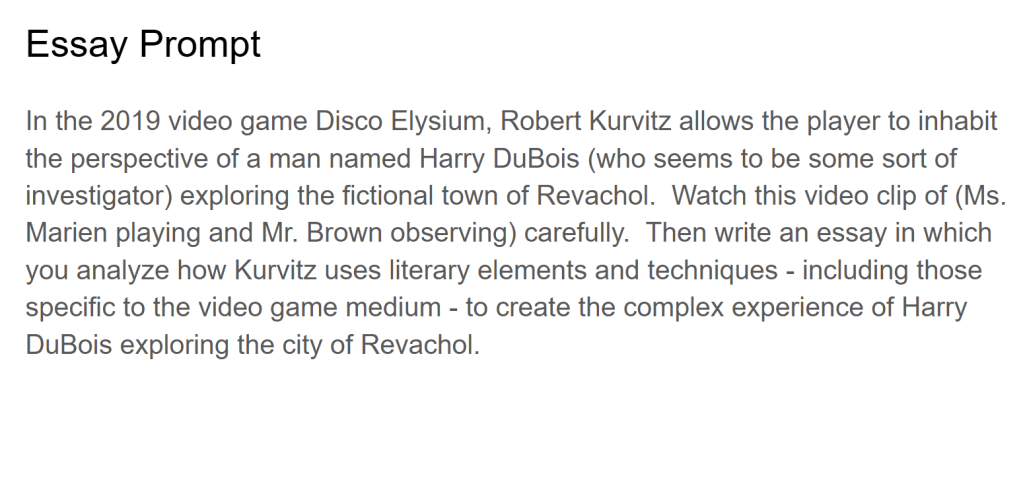
After showing them this prompt, I then had them watch the aforementioned video (which runs to about 15 minutes) – that’s one of my colleagues, who works as a technology coach at our school and yours truly, in the corner narrating:
After they watched the video once through, I posted the video in Google Classroom so they could review portions in order to help their close reading. I would say about half of them took me up on the offer.
I was clear with my colleague that I wanted this to be totally fresh and unplanned. She and I didn’t prepare, and she had never played the game before. I had, but I tried my best to pretend I hadn’t, narrating/annotating as the co-pilot while she steered the ship.
Their essays didn’t wow me – this was, after all, two weeks from the end of their senior year, and senioritis is real – but I could definitely tell them their heads were definitely in the game when they wrote them. A couple of kids came out of the woodwork – mostly boys who had previously struggled with distinguishing between technique and summary. And in general, kids who had been strong writers all year were strong writers in this context, and of course, the opposite was also true. I’m not going to pretend that there was some sort of revolution in the classroom, but it was a sort of silent confirmation that they could do this (with some direction) that it could help their overall Q2 skills (given the opportunity for reflection) and also that they found the experience genuinely interesting.
Here are some interesting passages from strong essays – this one was interesting in the way it connected aspects of game-making to each other:
The audio and spoken/written language serve as the character’s source of information and memory. The game represents the thoughts and feelings of the characters as separate entities from the player themselves. For example, at the beginning of the game, it shows the limbic system talking to the main character. Kurvitz does this to show that the game is in control of what the character learns about himself. This demonstration of control makes what should be the player learning about the character into enforcing the idea that the player has no control over what they think or remember, another example of the illusion of control found throughout the game. Kurvitz is intentional in making it seem like the player is in control by allowing for responses by the character, but they often end in a loop until the “right” response is chosen. This is a point where the spoken language component crosses with the interactivity of the game, allowing for a more intense belief that the character is in control of their thoughts, when it’s really the game.
This one was reaching for the broader context of the literature and literary concepts we had studied earlier in the year:
DuBois’s lack of autonomy stems from two things: the construction of the game itself and the mind of his character. DuBois wakes up and knows absolutely nothing about himself, the world around him or the body he inhabits. This is a classic use of the amnesia trope, one that is very common in a lot of rom-coms, soap operas, and telenovelas. The concept is that the character wakes up knowing nothing, and the other characters around him help him find out what he needs to know to fulfill some kind of prophecy or finish some sort of job. While there were no other people present in the game that Ms Marien played, there were guiding forces at play during her game, and had she left the room she would have encountered other people who also could have helped DuBois figure out his purpose in the world. This trope of amnesia goes much deeper than just someone who lost their memory, though. At its core, it’s about community and leaning on the people around you. Revachol looks like an absolutely horrid place to live, and at first glance looks a lot like what I pictured St. Petersburg to be when I read Crime and Punishment. That being said, I believe that both characters (DuBois and Raskolnikov) are placed in places of such discomfort for a reason, that reason being the intentionality that must exist when trying to form connections in difficult places. The game that Ms Marien played mainly showed written and verbal language in the form of choose-your-own-adventure prompts or directions, but the ominous music also contributed to Revachol’s creepy atmosphere.
This one made really great strides to explore the relationship between game mechanics and broader conceptual exploration of free will and determinism. Something else cool that happens here is the student contrasts her own playthrough with the one we watched, as an additional source of analytic material, something I didn’t even realize could happen until I saw some kids do it:
The illusion of choice is possibly most prevalent through the mechanism of investigating the world around you through Harry’s lens. By pressing tab, all the objects you can interact with in a room are highlighted, and it is much easier for the player to understand what they can do. The player can then put clothes on Harry, pick up objects, and maybe most importantly, interact with the things around them. When Ms. M was faced with the task of getting her tie from the spinning ceiling fan, she was forced into a ‘skill check’, something she had to deal with multiple times to interact with various items. She failed the skill check, but upon failing it, the game redirected her to turn off the fan and try again. For other tasks, failing the skill check meant an opportunity to do something was permanently lost, like assessing the damage to the window. This skill check mechanism of investigation allows the player to think they are capable of doing any task offered to them in the game, but this isn’t true. The game points you in the direction it wants you to go, like the tie, or bans you from making that choice, like the window. This is an expert way to lure the player into the idea that they can make decisions, but those decisions will all ultimately lead them down the preconceived path the game-makers made. This is meant to express the idea that Harry’s journey is all planned out, despite the fact that you are not aiming to make that happen. His journey is laid out before him, and he is your vessel to poke around the world while walking down that predestined path. Additionally, you can pick from various archetypes at the beginning of the game, ranging from ‘the Thinker’ to ‘the Fighter’ to building your own. Each archetype allows for boosted stats in some categories and lowered stats in others. This aids or hinders the player in the different skill checks, because it determines your ability to do well in certain tasks. However, the level of success you have in tasks is ultimately randomized. We saw Ms. M fail a skill check that she had 93% success odds for, and on R’s and my playthrough, we succeeded in a 18% success rate roll. This is another tool in establishing the idea of free will for the player. The way you do on these rolls is random, meaning there is no way to confirm your path, no matter how much you want to do so. This furthers the idea that Harry’s journey is preconceived. His choices are not up to him as a person, but also not up to us as players. This randomness and illusion of free will represent how fate simultaneously has a plan for everyone and also blocks any attempt to control it.
Notes to Future Self (or you so you don’t repeat my mistakes)
Tech support – One of the biggest issues is predictable but will still be annoying: technology. You think you have everything set up, and then someone’s speakers don’t work, or their save-game is deleted, or their recording app isn’t cooperating. I would suggest building in extra time for things like this. Maybe you’re a better teacher than me and you already do that. But I didn’t and sometimes it made it a less productive or engaging experience for students than it might have been. There are a lot of moving parts, more than asking them to take out a book or watch a movie. Things can go wrong.
Sequencing – If I had this to do again, I would begin the unit with the 8-bit games (Metroid and Kid Icarus). It will feel silly to them perhaps, which would be a good thing I think, and it would be a more natural sequence. They’d analyze two relatively simple games, build their analytical chops with things they think they can do, and then move on to a more much difficult, confusing and yes, literary game, like Disco Elysium and now they will see its complexity as complexity, cast against the simple background. Starting with the 8-bit games would also create a sense of history, something that I always think is good because it gives them intertextual kinds of opportunities too. I don’t think Harry DuBois is based on either Samus Aran or Pitt, but I do think that the sense of “video game that begins with a stranger in a strange place” is itself a trope that they can learn the history of, especially if you had more time.
Other Assessment Ideas – I would like in the future to give students videos of other students playing, and then have them in term make recorded video analyses (perhaps in lieu of essays) They could isolate video evidence more clearly and describe it verbally while it was on the screen. Then again, the essay form requires them to do some sort of translation that may be in itself independently valuable.


