
[This post is part 5 of a series on teaching the Kendrick/Drake Beef – click here for part 4 –“Poetic Justice” – Even When They Were Friends There Were Issues]]
For about the first two weeks of the unit, the class had now listened to and analyzed several songs – “Ab-Soul’s Outro” (Ab-Soul featuring Kendrick Lamar ), “So Appalled” (Kanye West featuring Jay-Z et al), “Hiiipower” (Kendrick Lamar) and “Poetic Justice” (Kendrick Lamar featuring Drake). Along the way my students had reviewed SOAPS, reviewed how to identify some types of figurative language, allusions and references, and connect those identifications to greater arguments about purpose, and then I added Henry Louis Gates’ Signifyin(g) framework into the mix of tools students could use to rhetorically analyze the songs we were now going to listen to.
From that point onward, my plan was that we’d listen to the ten (sort of, 12) core songs that make up the very public feud that Kendrick Lamar and Drake entered into in 2023-2024.
For reference, here’s a list of songs, performers and release dates:
- “First Person Shooter” – Drake featuring J Cole – 10/24/23 ← WE’RE HERE
- “Like That” – Metro Boomin featuring Future and Kendrick Lamar – 3/26/24
- “7 Minute Drill” – J Cole – 4/5/24
- “Push Ups” – Drake – 4/19/24
- “Taylor Made Freestyle” – Drake featuring AI Tupac/AI Snoop Dogg – 4/19/24
- “Euphoria” – Kendrick Lamar – 4/30/24
- “6:16 in LA” – Kendrick Lamar – 5/3/24
- “Buried Alive Interlude Pt 2” – 5/3/24
- “Family Matters” – Drake – 5/3/24
- “Meet the Grahams” – Kendrick Lamar – 5/3/24
- “Not Like Us” – Kendrick Lamar – 5/4/24
- “The Heart Part 6” – Drake 5/5/24

I’ve always assumed that’s a picture of a GOAT.
Socrates and Euthyphro; Kendrick and Drake
I am definitely going to get into the weeds about “First Person Shooter” in this post but before I do, I want to make a different point: the argument Kendrick and Drake had has a lot in common with a Socratic dialogue. In Plato’s Socratic dialogues, one person who is not Socrates usually enters arrogantly, believing themselves to be clear-headed about some philosophical idea or concept; Socrates questions that person, gets them to acknowledge (sometimes reluctantly) that they don’t understand what they thought they knew, and then Socrates works with that person to come up with a better answer.
In my Lang class, for years I’ve worked with Plato’s dialogue called “Euthyphro” to explore this structure, and also to allow students to develop their own dialogues and then dialogue-like essays. Socrates and Euthyphro argue about what “piety” means, each for their own reasons. Euthyphro is a lawyer who has decided to prosecute his own father for murder; Socrates has been accused of speaking with the gods, and lying to children about theological matters. Euthyphro believes he’s on firm footing because he knows that piety is; Socrates strategically flatters then cross-exmaines him, Euthyphro admits he’s confused, then the two begin a deeper conversation about what piety might really mean, but then Euthyphro still leaves convinced he’s doing right in prosecuting his own father.
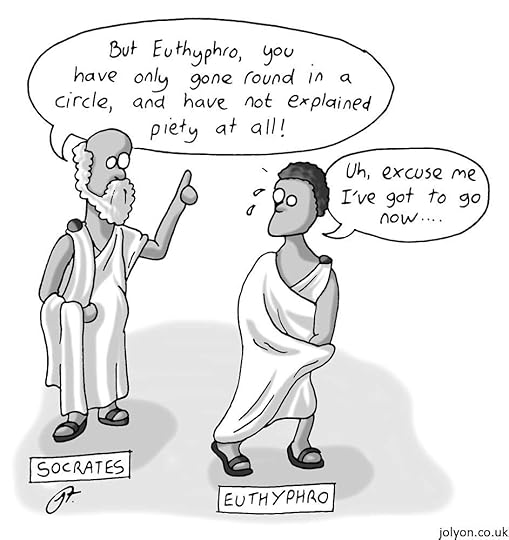
My favorite version of the unit has been for us to read “Euthyphro” as a class over the course of a few days, working to identify its core structure, and then have students construct their own dialogues about their own topics, following that structure. Yes, Euthyphro and Socrates are arguing about the specific issue of piety, but their specific arguments helps students see a broader pattern: more generally, they are reading about people arguing about how to define an ambiguous and morally weighty word, and also seeing how that relates to another moral argument. So once students got a sense of how Plato constructed his argument, they would be in a position to argue theirs. I think it’s a cool assignment for later in the year in Lang, where students learn more about what can make a line of reasoning sophisticated- getting beyond “counterargument paragraph” to something deeper. They pick their own topics, choice things like how to define race or gender (biological or social?), what makes a sport a sport (ie. chess? cheerleading?), what makes a family a family (parents’ genders, number of parents, biological bonds?), the basis of teachers’ or deans’ authority (“because I said so?”), citizenship (residency, country of birth, parent’s birth country?), and many more, depending on their core interests. It’s a very difficult assignment but also very rewarding once they get their heads around their topic/concept.
What I realized when I was planning this Kendrick/ Drake unit was that, at least from one perspective, Kendrik and Drake are also having a Socratic dialogue. Their Socratic topic is: what makes someone the GOAT – the greatest of all time? Specifically, what makes someone the greatest rapper of all time? That’s a definitional debate. It’s a debate hip-hop fans have all the time. Same with sports fans – “Michael Jordan or LeBron?” is an argument I’ve had a full generation of students ready to debate. And they often know a lot about how to do that too – how to debate not only the surface topic, but the underlying criteria, how to compare them, assess who does or does not meet them, and so on. In my opinion it’s one of the only things sports radio really does well.
What I think makes the Kendrick/Drake feud specifically Socratic is that over the course of the argument, it becomes deeper and more philosophical. What is initially just sparring about conventional topics (sales vs. lyricism, popularity with women, wealth, etc.) becomes something about authenticity, race, the purpose of art and its relationship to social criticism.
Rap Beef as Argument, Rhetorical analysis and Synthesis All in One
Combining the Drake/Kendrick and the Socrates/Euthyphro threads, what I had in mind was for students listen to these ten songs in order, and also have them read “Euthyphro” a few pages at a time, and help them see the way that the two contexts had more in common than they’d probably have imagined prior. Along the way they’d learn a lot about rhetorical analysis– by looking at how the artists argue and reply to each other in a very public context, to “win” the beef, and also argument, looking at how the two artists (and Socrates and Euthyphro) used evidence to create a line of reasoning and whether they succeed or fail. And of course holding all these sources in dialogue with each other would be good synthesis practice too.
What we did in class wasn’t that high-tech. I gave students a packet of lyrics for the 10 songs, and a copy of “Euthyphro.” Each day we’d listen to that day’s song, annotate its lyrics, then read a few pages of Plato (sometimes out loud, sometimes in small groups, sometimes silently) and annotate that. I gave them some annotation strategies, asking to look out especially for where the rappers made more abstract arguments about criteria, and also asking them to trace the development of Socrates/Euthyphro’s claims (the vocabulary makes tracking development difficult, so I do a lot of out-loud reading and parsing, at frist modelling myself them moving to having them do the same in groups). After each reading/listening we’d pause and discuss. Then at the end of class I’d ask them to make connections. I also gave them a graphic organizer that allowed them to track larger themes, important lyrics and their own running judgments of who was winning and why.
One key thing I tried to talk with them a lot about was “factors” – in just the way that word gets used on some year’s AP Lang synthesis prompts – like from the 2025 exam: Write an essay that synthesizes material from at least three of the sources and develops your position on the most important factors that space agencies and nations should consider when dealing with the problem of space debris. “
The question I charged them with answering eventually was, who wins the argument about “who’s the GOAT,” and based on what factors. That’s two layers of argument. First, there’s the more abstract “what factors best define GOAT-ness and why?”, and second, there’s the more concrete “once we have selected factors to judge the debate, who wins, and why?” My intuition was that both artists had their own definitions, and they sometimes argued at the first level, and sometimes the second. But because it’s hip-hop, they do that in a very condensed, rapid-fire and allusive manner, one that requires quite a lot of reading and reasoning stamina, as well as a lot of cultural investigation, to discover and reason through. In fact as the beef moved along, focus on different factors, arguments for and against them as factors, and also arguments about whether Drake or Kendrick should win based on that factor alternately proliferate and consolidate.
By the end of the unit, they would do two major assessments: (1) a group rhetorical analysis podcast-style recording, where, working in a group of 2-3, they would analyze one of the 10 songs, making claims about purpose and audience, and then exploring the song verse by verse to construct an interpretative argument. (2) an individual synthesis-style essay that worked with the 10 songs as sources, and answered the question, based on this debate, what are the most important factors that determine greatness in hip-hop, and based on those factors, who won the debate and why?
We worked through each song and section of “Euthyphro” for several days in a row. What I’m going to do for the rest of these posts is explore what we found out about each song and what connections between Kendrick/Drake and Socrate/Euthyphro emerged.
“First Person Shooter” – Drake’s Opening Shot?
Broadly speaking, Drake is the Euthyphro figure in this dispute. He’s very confident (at least initially), he’s more socially powerful than Kendrick in some ways, and he has no problem strutting his stuff. In “First Person Shooter,” he asserts his dominance, with the help of feature artist J Cole on the song’s second verse. As we’ll see in future posts, Kendrick goes to work on this in a way very similar to how Socrates questions Euthyphro – where Socrates asks “what is piety?” Kendrick, featuring on a song by Metro Boomin and Future, asks this Socratic question: “is you like that?” We’lll talk about what “that” is in the next post. For now, I want to dig in on what Drake and JCole have to say, how they say it, and why I think it set off such a fight.
And yes, the video starts with what looks like an Office episode.
THESIS STATEMENT: Drake’s central purpose is to convince his audience (initially his own fans, and secondarily a broader hip-hop audience) that he’s the GOAT, using an extended simile that is woven throughout the song- “big as the Super Bowl.” Working within this analogy, in the first verse Drake focuses especially on how women feel about him. Next, J Cole tags in and expands the song’s argument to his lyricism and musical versatility – significantly identifying himself, Drake and Kendrick Lamar (who’s not on the recording) as “the big three” of the GOAT conversation. Last, Drake in the 3rd verse, delves further into the popularity-with-women argument, and also to establish pre-emptively that sales are more important than critical recognition as a factor in determining GOATness (not that he knew Kendrick would have anything that about that at the time – it’s really more shadowboxing at this point). The song is pretty conventional – a five-paragraph essay, with intro, 3 verses and an outro. Along the way I’ll talk not only about what’s said but how the musical and structural aspects of the song interact with this argument.
A question you may ask right away is – if they also say Kendrick is great too, what’s the big deal? Look what the first Youtube commenter says:
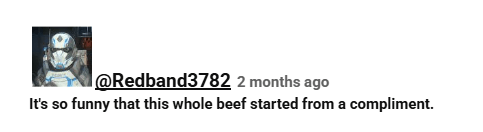
I want to say, yes and no, But that will mostly wait for next time when we see how Kendrick took that “compliment.”
Let’s look at how the song starts:
First-person shooter mode
We turnin’ your song to a funeral (the one for you)
To them niggas that say they wan’ off us
You better be talkin’ ’bout workin’ in cubicles
Yeah, them boys had it locked, but I knew the code
Lot of niggas debatin’ my numeral
Not the three, not the two, I’m the U-N-OYeah
Numero U-N-O
Me and Drizzy, this shit like the Super Bowl
Man, this shit damn near big as the-
Big as the what? Big as the what?
Big as the what?
J Cole begins by naming the gaming reference built into its title – “first-person shooter mode” – a first-person shooter is a game like Fortnite or, if you’re old like me, Doom or Quake, where players attempt to kill enemies from a first person perspective; “mode” is a word that also draws on gaming culture, wherein a “mode” is a setting with a game, but also something that’s gone more culture-wide (i.e, football star Marshawn Lynch’s nickname “Beast Mode”). In a first-person shooter, sometimes you’re fighting computer-spawned bad guys, and sometimes you’re fighting other players. It feels to me like J Cole is talking about the player-vs-player version here. Like he’s switching himself into “first person shooter mode,” rather than what his music usually does – in other words, establishing the purpose of the song in its first four words as a competitive attack on his rivals. He’s boasting that he can defeat his adversaries and naming that that’s what this song will be doing. “We turnin’ your song to a funeral” is layered a bit – not only is he good, he’s good at rap performance, and after you hear him, your song will feel like a funeral (slow, sad) and will also signify that you’ve lost, you’ve died. When he says “Me and Drizzy, this shit like the Super Bowl,” he’s referring to his performance partnership with Drake (Drizzy is one of Drake’s nicknames). When he says it’s like the Superbowl, he’s saying they’re involved in a competition at that level, and also that they’re at that level. That they’ve commanded that large of an audience.
The chorus draws on that last idea through repetition – anaphora to be more specific – and provides a transition to Drake’s first proper verse that makes it clear what “big as the…” is anticipating – the Super Bowl:
Big as the Super Bowl, but the difference is
It’s just two guys playin’ shit that they did in the studio
N****s usually send they verses back to me
And they be terrible, just like a two-year-old
I love a dinner with some fine women
When they start debatin’ about who the G.O.A.T
I’m like go on ‘head, say it then, who the G.O.A.T.?
Who the G.O.A.T.? Who the G.O.A.T.? Who the G.O.A.T.?
Who you b****s really rootin’ for?
Like a kid that act bad from January to November
N****, it’s just you and Cole, big as the what?
We do get the official declaration of intent here with the repetition of “who the GOAT?” Most of this reads to me pretty straightforward. We’re really good at this, but we’re really just messing around in the studio, no big deal. When others try to sell me on their music, it’s not as good. And sometimes I go out with women. I love it when they start arguing because then they’re forced to admit it’s me, and then they like me even more. Implicitly saying two reasons he’s the GOAT 1) that he’s surrounded by “fine women,” 2) that he’s good at music.
The last line is a clever punch-line. One of my students had to show this to two of his podcast partners. He’s like “okay guys, like if you’re acting badly, for 11 months of the year, what do you get for Christmas?” He holds his hands up as they slowly realize – “COAL!” – J – COLE to be specific – and that line passes the mic back to J Cole for his verse, which follows immediately after the chorus:
N**** so thirsty to put me in beef
Dissectin’ my words and start lookin’ too deep
This is actually an implied criterion argument: how do we figure out who’s the GOAT? Not by looking at lyrics “too deep.” So by something else – maybe the vibe created, the persona? How danceable it is?
I look at the tweets and start suckin’ my teeth
I’m lettin’ it rock ’cause I love the mystique
I still wanna get me a song with YB
Can’t trust everything that you saw on IG
Just know if I diss you, I’d make sure you know
Know that I hit you, like I’m on your caller ID
I’m namin’ the album The Fall Off
It’s pretty ironic ’cause it ain’t no fall off for me
Still in this b****, gettin’ bigger
They waitin’ on the kid to come drop like a father-to-be
Love when they argue the hardest MC
Is it K-Dot? Is it Aubrey? Or me?
We the big three like we started a league
These are the big lines that in fact do seem like a compliment, but also did seem to set Kendrick Lamar off. More on that next time. K-Dot is Kendrick Lamar’s nickname; Aubrey is Drake’s real name, obviously “me” refers to J Cole himself. And what he’s saying is that the three of them are all at the same level. He does like when people “argue the hardest MC” – as in, who’s the GOAT, but his answer: “We the big three like we started a league” – we’re all at the top together.
But right now, I feel like Muhammad Ali
Huh, yeah, huh, huh-huh
Yeah, Muhammad Ali, the one that they call
When they shit ain’t connectin’ no more
Feel like I got a job in IT
Rhymin’ with me is the biggest mistake
The Spider-Man meme is me lookin’ at Drake
J Cole cleverly pivots asserts his own superiority even within the “big three” compares himself to Muhammad Ali, the greatest boxer of all time, and then notes that he’s who people call “when they shit ain’t connectin’ no more” – is he saying that about Drake? Probably not. Maybe just more generally. But it is true that he’s been brought in to feature with Drake on this song. I don’t know. We can also read this as playful rivalry – J Cole isn’t dissing Drake, he’s more wryly saying “yeah you know you need me on this track, I’m the real secret weapon here” kind of tone.
It’s like we recruited your homies to be Demon deacons
We got ’em attendin’ your wake
This is clever punchline/pun – Wake Forest’s mascot is the Demon Deacons, the idea being that your fans become his fans, again meaning, your success dies and then they attend its wake.
Hate how the game got away from the bars
Man, this shit like a prison escape
Everybody steppers, well, fuck it, then everybody breakfast
And I’m ’bout to clear off my plate (huh, huh, huh)
When I show up, it’s motion picture blockbuster
The G.O.A.T. with the golden pen, the top toucher
The spot rusher, sprayed his whole shit up, the crop duster
Not Russia, but apply pressure to your cranium
Cole’s automatic when aimin’ ’em
With The Boy in the status, a stadium
N****
Here’s the straight-up assertion – he’s the “GOAT with the golden pen,” the person with the best lyrics (even though earlier he told us we shouldn’t analyze them too deeply). Describing victory though a bunch of different metaphors (eating, writing golden words, touching the top, football running back, crop-dusting a whole field, eastern European warfare). That Russia line exhibits another pun – “Your cranium”/Ukraine – which one of my students audibly responded with “did J Cole just tell a dad joke?” energy.
Then we get Drake’s final verse, which says some things that become important later, fleshing out reasoning about relative priorities:
I’m ’bout to click out on this shit, I’m ’bout to click, whoa
I’m ’bout to click out on this shit, I’m ’bout to click, whoa
I’m down to click down you hoes and make a crime scene
I click the trigger on the stick like a high beam
Man, I was Bentley wheel whippin’ when I was 19
She call my number, leave her hangin’, she got dry-cleaned
She got a Android, her messages is lime green
I search one name and end up seein’ 20 tings
Nadine, Christine, Justine, Kathleen
Charlene, Pauline, Claudine
Man, I pack ’em in this phone like some sardines
And they send me naked pictures, it’s the small things
You niggas is still takin’ pictures on a Gulfstream
My youngins richer than you rappers and they all stream
I really hate that you been sellin’ them some false dreams
Man, if your pub was up for sale, I’d buy the whole thing
Drake’s main GOAT claim here are his wealth (hence the Bentley when he was only 19) and his success with women, which he establishes through a catalog of rhyming women’s names – and a catalog like this suggests how much longer it might be, and simile (packing their numbers into his phone “like sardines” – things tightly packed that don’t have much value by themselves, that he can’t even keep straight so he has to use the search function).
Will they ever give me flowers? Well, of course not
They don’t wanna have that talk, ’cause it’s a sore spot
They know The Boy, the one they gotta boycott
I told Jimmy Jam I use a GRAMMY as a door stop
I think these few lines are actually really important later – he’s preemptively answering counter-arguments. Though he has met with all this financial and women-amassing success, he knows he’ll never really get that critical recognition (“flowers? Well of course not”). But he thinks that says more about them than him (“it’s a sore spot”). Using another nickname for himself – “The Boy” – he notes that he’s the one “they gotta boycott” – he’s building a resentment narrative, and one he augments though himself-in-the-3rd-person (illeism, about which more below). And again he professes not to care about Grammys either – either because he has so many, or because they’re worthless, or both, he uses them “as a door stop.”
Girl, gave me some head because I need it
And if I fuck with you, then after I might eat it, what?
N****s talkin’ ’bout when this gon’ be repeated, what the fuck, bro?
I’m one away from Michael, nigga, beat it
N****, beat it, what? Beat it, what?
Beat it, what? Beat it, what?
Beat it, what? Beat it, what?
Beat it, what? Beat it, what?
Beat it, what? Beat it, what?
Beat it, what? Beat it, ay
Beat it, what? Don’t even pay me back on none them favors
I don’t need it
As the song ends Drake makes two allusions that prove pretty big for what comes later – “one away from Michael” seems to refer to Drake having only one fewer number one hits than Michael Jackson (which was true in 2023 when this song came out). This again implicitly assumes that commercial success is what makes a GOAT a GOAT. And then the repeated “beat it,” riffing on that Michael Jackson reference with the chorus of Jackson’s song of the same time.
Lastly he suggests that whatever he’s done for anyone, he doesn’t care for them to repay him, as he’s already bigger than that anyway. Overall, this final verse not only reiterates earlier claims, but also girds Drake against accusations he knows are often made against him: that he’s not talented or worthy of critical acclaim, just popular. His answer, in summary, is to attack the attackers: it says more about those critics than it does about him that they won’t give him “flowers.”
Drake and Euthyphro
Socartes’ dialogue begins with Euthyphro boldly and arrogantly explaining his life choices and the expert theological knowledge that underpins them. Euthyphro feels very sure that he’s right to charge his father for murder, because he knows all about the Gods, and what it means to obey them. Look how he answers Socrates’ question:
SOCRATES: Good heavens, Euthyphro! and is your knowledge of religion and of things pious and impious so very exact, that, supposing the circumstances to be as you state them, you are not afraid lest you too may be doing an impious thing in bringing an action against your father?
EUTHYPHRO: The best of Euthyphro, and that which distinguishes him, Socrates, from other men, is his exact knowledge of all such matters. What should I be good for without it?
Drake actually does something really similar:
Will they ever give me flowers? Well, of course not
They don’t wanna have that talk, ’cause it’s a sore spot
They know The Boy, the one they gotta boycott
I told Jimmy Jam I use a GRAMMY as a door stop
The stylistic decision both Euthyphro and Drake make to revel in unrepentant illeism – emphasizes their confidence in their respective disciplines – Euthyphro as a theologian an Drake as a rapper.
Again echoing that same boastfulness. Here’s how Euthyphro describes his own divide knowledge and how others see it – and notice he ropes Socrates in with some presumed agreement/friendship:
…for when I speak in the assembly about divine things, and foretell the future to them, they laugh at me and think me a madman. Yet every word that I say is true. But they are jealous of us all; and we must be brave and go at them.
And just as the gods have done things like this, so too can Euthyphro. If Drake is “big as the Superbowl,” Euthyphro is as big as Zeus:
For do not men regard Zeus as the best and most righteous of the gods?—and yet they admit that he bound his father (Cronos) because he wickedly devoured his sons, and that he too had punished his own father (Uranus) for a similar reason, in a nameless manner. And yet when I proceed against my father, they are angry with me.
It’s interesting to me that both Drake and Euthyphro seem to regard themselves as very skilled and accomplished, but then also, resentful that they don’t get seen for what they are. And that resentment, at least for Drake, will come into play hugely later on as Kendrick engages with his boasts.
The Beef Hasn’t Even Started Yet
For now, J Cole and Drake’s reasoning stands on its own: they sell a lot of albums, girls like them, the are wealthy and successful – ergo, they’re the GOAT – big as the superbowl. And Euthyphro’s argument is similar: he knows a lot about piety, because he’s a successful lawyer and very intelligent, known for this knowledge, and if Zeus can banish his own father from Olympus, Euthyphro can try his own father for murder. [Also, more on Drake’s won father, and murder, later]
Whatever Kendrick thought about this song and his being named in it, he stayed quiet for a long time. His real foray into the dispute didn’t come until March of the following year, with his surprise feature verse on “Like That,” where just like Socrates, he begins a dialectic demolition of Drake’s argument by asking a simple question – “is you really like that?”


One thought on “Teaching the Drake/Kendrick Beef – First Person Shooter – Rap Beef as Socratic Dialogue”