
[This post is part 4 of a series on teaching the Kendrick/Drake Beef – click here for part 3 – “Hiiipower” and “So Appalled” – How Kendrick Signifies on Kanye]
A final lesson I did leading up to my students studying the beef itself was about Kendrick Lamar and Drake co-performing on the 2012 song “Poetic Justice.” Listening to the song and having students analyze it gave them some room to understand both artists’ divergent styles and ambitions, see their one-time friendship, in a moment of productive artistic tension (a tension that was not yet personal animus). It also allowed them to explore the way a love song might signify beyond that – in other words, more practice with Henry Louis Gates’ signifyin(g). I’ve since learned that Kendrick featured on a Drake song around that same time – on Drake’s 2011 album Take Care. If I had this to do again, I might have delved into that too. While we were doing these lessons, several students and one colleague recommended that album to me. I have listened a couple of times, and I did like it – reminds me of Frank Ocean from around that time. But I didn’t include it so I don’t have a lesson to describe.
On “Poetic Justice,” Kendrick performs on verses 1 and 3, plus the chorus, with Drake featuring on verse 2. And there’s a Janet Jackson sample woven throughout.
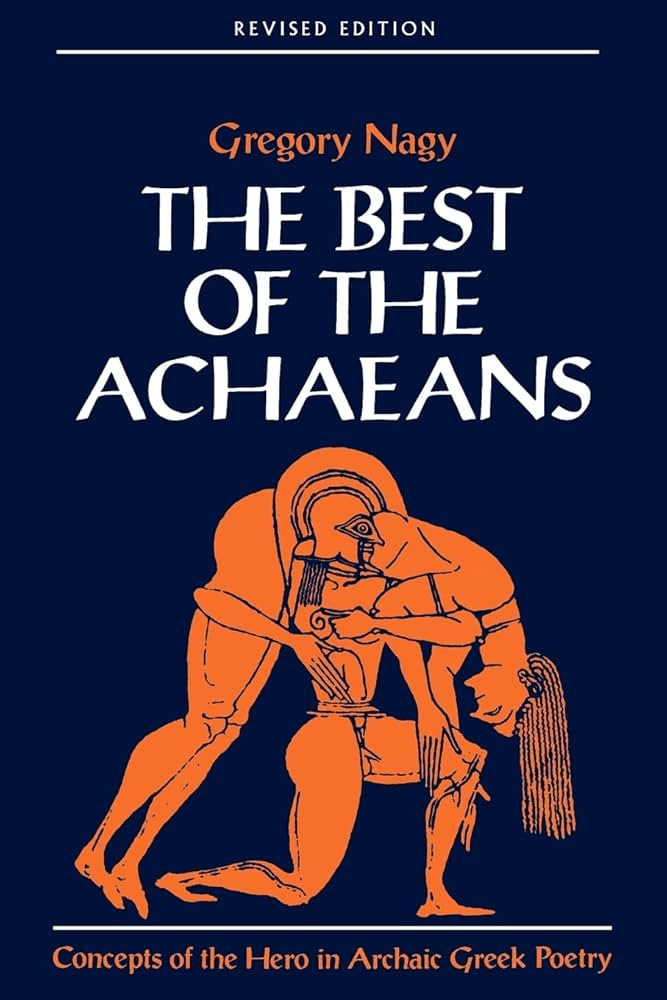
There is a lot of interesting contrasting energy there, and my students were definitely curious to draw those contrasts. To me, at some level (though I didn’t really talk about this in class), this song exhibits what Gregory Nagy sees as two competing and incompatible traditions that he sees represented in each of the two great Homeric epics. Going a step further, in a lot of ways the 2024 beef as a whole is a great epic conflict – like of Odysseus and Achilles somehow indeed up in a battle. Think about the conflict between Odysseus (Odyssey) and Achilles (Iliad). Both of them are referred to in their respective epics as “the best of the Achaeans.” Nagy sees their two epics as answers to a traditional question raised in ancient epic – the trope of “force or cunning” – and which would defeat Troy. We see echoes of this in little bits in each epic – Achilles kills Hector with his sword and is always “swift-footed Achilles”; Odysseus masterminds the Trojan horse stratagem, and he’s “Odysseus the man of many schemes.” In the early books of the Iliad, this conflict manifests a few different ways. In some ways Drake (force) vs. Kendrick (cunning) in 2024 was like Achilles and Odysseus actually squaring off. And what are they arguing about? “Who that GOAT” is almost literally Nagy’s question – who is “the best of the Achaeans”? I’ll explore this more in future posts.
“Poetic Justice” is its own entry into a similarly contrastive hip-hop/R&B trope – the trope of liking someone for their body or for their mind. This is a false binary of course but the song explores the tension, and along the way, broadens to consider the relationship between love as an emotional feeling for a person vs. love as a broader political commitment – per Cornell West, justice being “what love looks like in public.” The song gets there through a punning allusion embedded into its title – to the 1993 film Poetic Justice, directed by John Singleton. Especially with the Janet Jackson sample – this song does what singifyin(g) does, according to Henry Louis Gates (which I tried to unpack in a previous post)- casts us backward into a tradition, and helps us read that tradition. This song is very much a re-telling (with a difference), a re-exploration of the film’s central trope – the player (Tupac as “Lucky”) humbled by genuine love (Jackson, named “Justice”). We can also see the tension between Kendrick’s verses and Drake’s as related to the difference in the relationships we see in the film – Lucky/Justice vs. Chicago/Iesha.
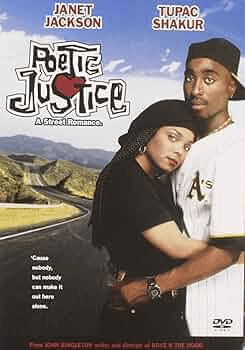
I made this explicit for students by summarizing the film for them, and noting how important Tupac Shakur is to Kendrick. If you don’t know, Tupac Shakur is one of Kendrick Lamar’s heroes. This is most explicit at the end of 2015’s To Pimp a Butterfly, where Kendrick, inspired by what he believes is a dream visitation from Tupac’s ghost, splices together his own words with footage from a 1994 interview with Tupac, in which they discuss the purpose of art in the context of oppression and the pursuit of freedom. I think if I had this to do again, I might select scenes from the movie so they could get a sense of the four main characters: Lucky (Tupac), Chicago (Joe Torey), Iesha (Regina King) and the eponymously named Justice (Janet Jackson). The film’s title is itself a pun – “poetic justice” as a phrase refers to someone getting their just deserts in a play, as well as the fact that Justice herself is a poet – she is poetic. So she herself is poetic Justice.
Furthermore, the film itself signifies on its own traditions – one of the central moments involves another trope, wherein three old aunties interrogate the naivete of young love. The three – Aunt April, Aunt May and Aunt June (the last is played by Maya Angelou – obviously – a poet, and also someone who appears later on Good Kid Maad City, the album that contains “Poetic Justice” and who John Singleton wrote into his original script – he wanted her to play that part “if I can get her”) questions Chicago and Iesha, themselves involved in a dysfunctional and codependent relationship. There’s a great interview where Dave Chapelle talks to Angelou about her deciding to be on the film, and talking to Tupac. Chicago, Iesha, Lucky and Justice have snuck into someone else’s family barbeque, but Aunt June (is it too much to read her as Juno?), even if she doesn’t see through their lies about kinship, does see through their pretenses to love and marriage. She questions them Socratically:
We PAN past the STERN FACES of Aunt April, Aunt May, and Aunt
AUNT JUNE
Are y’all in love?
IESHA AND CHICAGO look at each other.
IESHA
Yeah.
AUNT MAY
Do you know what love is child?
IESHA
No.
AUNT APRIL
How can you be in love if’n you don’t know what it is?
IESHA
That’s just how things go.
The three women are quiet for a moment.
…
Later on in the sequence, Aunt June holds forth at greater length:
AUNT JUNE
I want to talk to you about morals. The morals of the young people today. It’s gonna get them in big trouble, I’m telling you. Because they act like they don’t know the difference between right and wrong. And this is the truth, and you see, one of the reasons is their parents. Their parents are not taking care of the children. They are not telling them the difference between right and wrong. But then – wait now – no ma’am, you have to listen – because part of the responsibility is the children because this is their life, it’s not their momma’s, it’s not their poppa’s – I’m telling you – they have to think for themselves – even if their momma and poppa didn’t do something about it – girl look – the children have to think and try their best to come on up, come on up – now take this girl here –
AUNT MAY
No
AUNT JUNE
Take this child – take this girl – that child ain’t been more married, honey, than the man in the moon – and she’s over there flirtin’ with another man talkin about she’s married – young…
AUNT MAY
She’s loose.
AUNT APRIL
Oh she’s not loose. You were young once.
AUNT JUNE
I was never flitty.
AUNT APRIL
She was never flitty.
The song “Poetic Justice” explores that same Socratic question by comparing two visions of love – Drake’s – flitty – and Kendrick’s – “never flitty.” But there’s that same attendant irony – even if Kendrick’s verse critiques Drake’s, so also Drake’s reminds Kendrick, just like Aunty April reminds Aunt June, not to take themselves too seriously.
Drake’s the hitmaker-Cassanova. Kendrick is the deep-thinking-romantic. And they’re both in the same song, both treating the same theme – “poetic justice” – from different angles. And competing even while they’re collaborating. This is something really unique to hip hop I’m only just learning to appreciate – the feature verse really has no equivalent in the alt-rock I grew up with (or any other kind of rock I don’t think). In a feature, you show what you’ve got. Given that you’ve been asked by the main artist to be involved you complete the song but also in a way that perhaps tries (but not too hard) to upstage it. Kendrick really picked the fight that started the 2024 beef in a feature on “Like That,” by Metro Boomin and Future, just like he did in 2014 on Big Sean’s “Control.” As Kendrick put it later on “Hood Politics,” “it’s funny how one verse can fuck up the game.” Drake’s verse doesn’t do that here, but it does add an interesting complexity to an otherwise straightforward theme. I wanted the class to see that too.
After the class listened to the song and I talked a little (but not too much) about Poetic Justice, the question I asked was something like “what is the essential tension within this song?” One of my goals for the unit was to help them understand what “complexities and tensions” really can mean – and this song seemed perfect for that. It’s a sort of polyphonic whole – it is a love song in some ways, and there are ways we can reconcile the verses into one continuous narrative, but more interesting to me is the ways we can’t resolve it. The ways Drake and Kendrick’s presences do not fit into a larger whole, the surplus meaning the song can’t contain.
This is probably, properly speaking, more AP Lit than AP Lang. It’s a love song. But it’s a love song that, the title subtly suggests, is more than a love song. As we’ve seen already, Kendrick had some pretty deep political and ethical convictions he’s always got on the table – and love feels like one “half of the truth” like he describes in “Ab-Soul’s Outro.” I think this song has a rhetorical purpose that subtly transcends its genre expectations, one that it’s fitting for an AP Lang class to explore.
My Own Reading of the Song
What followed is based on ideas I had and thoughts students shared during the different class discussions. Overall, I read the song as answering the question, what does love mean in the context of a culture that is not loving, in fact oppressive? This is one of the questions that Justice’s character asks in the film in a lot of different ways, through her poetry, which is often delivered via suggestive voiceover (and which was in point of fact written by Maya Angelou). Exploring that question also embeds a call to action: Kendrick is asking his audience to reflect on how to orient themselves towards justice by meditating on its relationship to love.
The song starts in a very conventional space of physical attraction and lust, with a distorted voice/danc- beat intro:
Every second, every minute, man, I swear that she can get it
Say if you a bad bitch put your hands up high, hands up high, hands up high
Tell ’em dim the lights down right now, put me in the mood
I’m talking ’bout dark room, perfume
Go, go (in the thundering rain)
The sound of Janet Jackson singing “In the thundering rain” brings in a level of introspection as the beat immediately slows. This creates a tension the song explores- between physicality and introspection.
The first verse is Kendrick’s- and I think he’s reckoning with a girlfriend who is cheating on him, and/or who won’t be seen with him publicly (or maybe it’s because she’s cheating with him with somebody else).
I recognize your fragrance, hol’ up
You ain’t never gotta say shit, uh
And I know your taste is a little bit, mmm, high maintenance, uh
Everybody else basic, you live life on an everyday basis
With poetic justice, poetic justice
If I told you that a flower bloomed in a dark room, would you trust it?
I mean, I write poems in these songs dedicated to you, when
You’re in the mood for empathy, it’s blood in my pen
Better yet, where your friends and them?
I really wanna know you all, I really wanna show you off
Fuck that, pour up plenty of champagne
Cold nights when you curse this name
You called up your girlfriends and
Y’all curled in that little bitty Range, I heard that
She wanna go and party, she wanna go and party
Nigga, don’t approach her with that Atari
Nigga, that ain’t good game, homie, sorry
They say conversation rule a nation, I can tell
But I could never right my wrongs ‘less I write it down for real, PS (anytime)
Maybe he recognizes her fragrance in his friend’s room – maybe the friend whose perspective we hear in Drake’s voice. “Hol up” is Kendrick both expressing his doubt and also shouting out his own song of the same name from a few years earlier on Section.80 (the same album as “Ab Soul’s Outro” and “Hiiipower”). He then slips into a more melancholy register – noting that she’s high maintenance, maybe being reminded of this from the smell of the perfume. Here he speaks the song title for the first to me – “poetic justice” – bringing us to the movie and the emotional space of the tangled relationship of Iesha and Chicago. He metaphorically compares himself to a “flower” that blooms in a dark room, and wonders if she “trusts” it. He notes that she comes around when she’s “in the mood for empathy” and that there’s “blood in [his] pen” – double entendre about sexual desire and also the violence of poetic inspiration (a double entendre Kendrick explores at song length on his 2024 song “Gloria.”)
But he wants more – he “really wanna know you all, really wanna show you off” but then makes another shout-out to an earlier song of his – “fuck that” is one of the first lyrics from the next track after “Hol Up” – “ADHD.” He’s sort of defending himself from the pain of worrying when she goes out, thinking no one’s game will be good enough for her – ‘N**** don’t approach her with that Atari” (i.e., bad, outdated game).
And the verse ends with lines both of Kendrick’s verses share with Drake’s (but with small differences):
They say conversation rule a nation, I can tell
But I could never right my wrongs ‘less I write it down for real, PS (anytime)
Here he’s gesturing towards a larger political context (only gesturing, it’s not a complete thought yet), and then the pun on right/write – righting wrongs from writing down, and also signaling that this song is at some level a love letter with “PS” (letter-writing is a form Kendrick will use much later on 2024’s devastating anti-Drake track “Meet the Grahams”).
The final moment – “anytime” again weaves in Janet Jackson’s voice (also invoking Justice’s initial skepticism about Lucky):
Then we get to the chorus:
You can get it, you can get it
You can get it, you can get it
And I know just, know just, know just, know just, know just what you want
Poetic justice, put it in a song, alright (anytime)
There’s a double meaning here I think “You can get it” and “I know just what you want” being both sexual – i.e., I’m sexually available and I know how to be a good lover for you – but also, he’s playing with this other level – that what “she” wants is “poetic justice” put into a song – both her just desserts for cheating, but also, and maybe more importantly, what she really wants is not necessarily sex (or not only sex) but also a real representation of justice, a thought that Kendrick deepens in the final verse.
Drake’s verse seems easier to read, but embodies similar tensions:
I really hope you play this ’cause oh, girl, you test my patience
With all these seductive photographs and all these one off vacations
You’ve been taken, clearly a lot for me to take in, it don’t make sense
Young East African girl, you too busy fucking with your other man
I was trying to put you on game, put you on a plane
Take you and your mama to the motherland
I could do it, maybe one day
When you figure out you’re gonna need someone
When you figure out it’s all right here in the city
And you don’t run from where we come fromThat sound like poetic justice, poetic justice
You were so new to this life but goddamn, you got adjusted
I mean I write poems in these songs, dedicated to the fun sex
Your natural hair and your soft skin and your big ass in that sundress, ooh
Good God, what you doing that walk for?
When I see that thing move, I just wish we would fight less and we would talk more
And they say communication save relations, I can tell
But I can never right my wrongs unless I write them down for real, PS (anytime)
Drake seems like he’s talking about wanting her to listen to this song – maybe because he and the voice from verse one have both figured out the two-timing, and have moved on. He’s confused – “it don’t make sense” – she’s been lying to him and taking “one off vacations… with [her] other man” (Kendrick?). He was trying to be conscious – noticing that she’s a “Young East African Girl” and wanting to take her “to the motherland” but also thinks she’s got her other man. And he laments her seeming to sell out – hoping that one day she’ll realize “you don’t run from where we come from.” Much later in 2204, Kendrick very visibly questions Drake’s claim to street credibility/legitimacy – especially on “Euphoria.” And an irony here also being perhaps the Drake doesn’t realize it’s Kendrick she’s getting with – she’s not running from where she comes from, on this reading – she’s actually seen Drake’s own lack of authenticity and his performance (that feels like a retrospective stretch but I’ll leave it there with that note).
We then see the most directly physical description, the thing that seems to define Drake’s verse, looking at the shape of her body – a moment two students read very differently in my classes.
I mean I write poems in these songs, dedicated to the fun sex
Your natural hair and your soft skin and your big ass in that sundress, ooh
Good God, what you doing that walk for?
When I see that thing move, I just wish we would fight less and we would talk more
Goung back to the Poetic Justice film subtext, whereas Kendricks verse felt more like Chicago/Iesha, the second verse, and this moment in particular, is the most Lucky/Justice sounding moment in the song (there’s an early scene where she taunts him with dirty talk about her body, mostly to tell him to back off). This being English class, it’s natural for students to experience discomfort in hearing these lines, even if they listen to music with lyrics much more explicit on a regular basis (and I think they do). Here’s what they did with this discomfort. Let me describe two actual student reactions.
Pearl (pseudonym – a white female student) developed the idea that in this song, we hear Kendrick being thoughtful and reflective, about love, poetry, love poetry, and justice. And in Drake’s verse, according to Pearl, we learn that he is misogynistic. Pearl found it fairly easy then to conclude that Kendrick was better than Drake, because more respectful to women. At some level she may have been saying what she thought I wanted her to say. But I also think she was saying something she believed.
Liana (pseudonym – a black female student) read this line entirely differently. She explained that in this line, she felt validated because Drake was honoring an aspect of Black women’s bodies that is often denigrated in public space. She said the line made her feel seen and respected. [But, some foreshadowing – when we went further into the beef and I asked her about this again, she told me she had come to believe that Drake was just being performative in that moment, attempting to seem cool with black women but she had come to see that Kendrick was right, that he was just exploiting his proximity to black women to perform his own Blackness, maybe making the above less of a stretch than it seems.]
What’s interesting to me is that Pearl got one level in – Drake said something objectifying, therefore Drake is bad. Liana got three levels in – (1) sure, it might seem objectifying, but (2) it’s actually affirming and countercultural, though on reflection it’s actually (3) performative pro-Blackness. Pearl could see gender and perhaps not see how race was coloring her quick judgment of misogyny, whereas Liana could see race and gender at work, intersecting, and use that to deepen her reading well below the surface. I say this not to say who’s right and who’s wrong. But more to explore what students’ ideas of multiple meanings really can be, even in the context of a single line.
These two readings were super-striking and thought provoking, and I think press past the “is rap misogynistic?” debate [short answer – in my opinion – our culture is misogynistic, and rap doesn’t show these tendencies more than any other area of our culture, but it takes much more flack for it, because Black people produce it]. I’ve used a reading by Imani Perry from her book Prophets of the Hood to help explore this terrain, but in this class anyway, the students explored it without the help of that scaffolding. I think this is all a great example of what “complexities and tensions” mean on the Sophistication part of the rubric.
Finally we get the shared-line sign-off:
And they say communication save relations, I can tell
But I can never right my wrongs unless I write them down for real, PS (anytime)
Now instead of “rule a nation” (Kendrick verse 1) we get “save relations,” focusing more on the romantic/physical love than the suggestion of broader political context. But we still build the sense that this is a letter (or a second letter from a different lover).
After the chorus repeats we get the last, most complicated verse – again Kendrick’s – that synthesizes a lot of what came before:
Every time I write these words, they become a taboo
Making sure my punctuation curve, every letter here’s true
Living my life in the margin and that metaphor was proof
I’m talking poetic justice, poetic justice
If I told you that a flower bloomed in a dark room, would you trust it?
I mean you need to hear this
Love is not just a verb, it’s you looking in the mirror
Love is not just a verb, it’s you looking for a maybe
Call me crazy, we can both be insane
A fatal attraction is commonAnd what we have common is pain
I mean you need to hear this
Love is not just a verb and I can see power steerin’
Sex drive when you swerve, I want that interference
It’s coherent, I can hear it, mmhm
That’s your heartbeat, it either caught me or it called me, mmhm
Read slow and you’ll find gold mines in these lines
Sincerely, yours truly
And right before you go blind, PS (anytime)
This verse creates an interesting meta feel by centering the act of writing the song itself, allowing Kendrick to signify on the live song genre. The line that most intrigues me – “Living my life in the margin and that metaphor was proof” does a lot at once. “Margin” here can mean he’s been marginalized in the relationship after he discovered her cheating. It can also mean he’s living in the margins of society. It can also mean he’s saying “within the margins” – meaning that he’s following the rules. It can also mean that he’s living his life as a writer – in the margins of his notebook. Or it can mean all of these at once. And he’s playing with that by telling us that “that metaphor was proof” – but proof of what? Especially since “proof” is the kind of thing needed in (criminal) justice. There’s a collision here, a metaphorical over- determination. Specifically the connection between romantic relationship and political oppression is something Kendrick explores much later on To Pimp a Butterfly’s “For Free?”, where his relationship with a demanding “high maintenance” woman actually becomes his relationship with the appropriative dominant culture of the rap industry, and gets positioned as an example of the United States’ habit of exploiting Black bodies more generally – the video makes symbolism that might sound like a stretch very explicit.
After re-quoting the first verse’s “dark room” metaphor, he puts a point Drake made more strongly than Drake’s “I hope you hear this” , which is a kind of revenge gesture. Kendrick moves towards a normative insistence – “I mean you need to hear this” because he thinks it will develop her self-reflection – “love is not just a verb, it’s you looking in the mirror.” That’s a request for self-reflection Kendrick repeats years later, very pointedly AT Drake, on “Meet the Grahams”: “Fuck a rap battle, this a life long battle with yourself.” Here, he’s clearly still wrestling with the sexual aspect too. He also tucks in a meta moment about how to read his song – consistent with everything we saw in “Ab-Soul’s Outro”:
Read slow and you’ll find gold mines in these lines
Sincerely, yours truly
And right before you go blind, PS (anytime)
This ”you” is directed not only to “her” in the fiction of the letter, but now also towards his listeners, as a kind of guide for understanding his lyricism in general – a kind of example I think of what Gates describes as the “trope of the talking book.” Kendrick is signifyin(g), using the love song and the trope of “I hope she regrets this” to carry a piece of interpretative advice for how to read this song and the tradition that produced it. Signing off as a letter, again, “right before” meaning time–wise, or “write before” (contrasted with “read slow”) like, explore your own ideas before, or “right” – correct – “get right” before your failure of introspection has deeper consequences. Again, stretching outside of just “her” towards a broader implication, even if that implication is never fully explicated. Better, in fact, that it isn’t – Kendrick’s strategy here is enthymemic I think. We, the listeners, “find gold mines in these lines” – he doesn’t unpack them for us, just suggests where we might start.
A Student Sample – Different Student Reactions
Students didn’t discover all of that at once – I’m freely combining what happened over three different sections, and also my own interpretive ideas. But also, I’m drawing on a student podcast that I’ve written about elsewhere – and on which the two students are very clearly dialoguing in a manner similar to the three aunties as quoted above (and consistent with the dialogue between Kendrick and Drake in this song). So after I had this year’s students wrestle with this song’s meanings, l played them that recording, from a few years ago.
The students who produced that podcast were Black students in a very racially diverse non-AP junior class. I played their recording for three less-than-diverse (because predominantly white) AP Lang classes. Two of them – themselves more diverse than the third – took to it immediately, appreciating the previous students’ contributions and style and seeing that there’s an advantage in what they called the “informality” of it. I wouldn’t use that word – they’re using a recognizable and consistent form, just a vernacular one. And I think that difference makes a differences.
The last of the three classes – and the most white – very disrespectfully and nervously laughed through the recording to the point where I needed to stop and talk to them about their behavior. This was a largely “high achieving” class. And some of the white kids in the class just could not hear the student work I was sharing as scholarly student work. One white student said “they didn’t even have a script!” and “they’re just using SLANG!” as if it was somehow self-evidently absurd that they had received a high grade. I did my best to explain that this recording was an example of what they’d need to do eventually to – speak their analysis of a song in an extemporizing, open-minded way.
So this raised some questions for me – if students were really this disrespectful when listening to other students whose work I was clearly flagging as important and good, what would happen when they got to the summative assessment, which would require them to record their own interpretive podcast of one of the songs from the beef? In fact, some of these same students tried to laugh their way through that too – all they could hear was people “using slang” and “joking around.” So when it was their turn, their podcast sounded like a warmed-over reaction video where all they really did was speak vaguely and appropriatively “Black.” And these again were “high achieving” students. They ended up re-doing the podcast recording three times (because they wanted a higher grade than the C they received before they were actually able to believe it was worth taking seriously. And eventually scratch out a B.
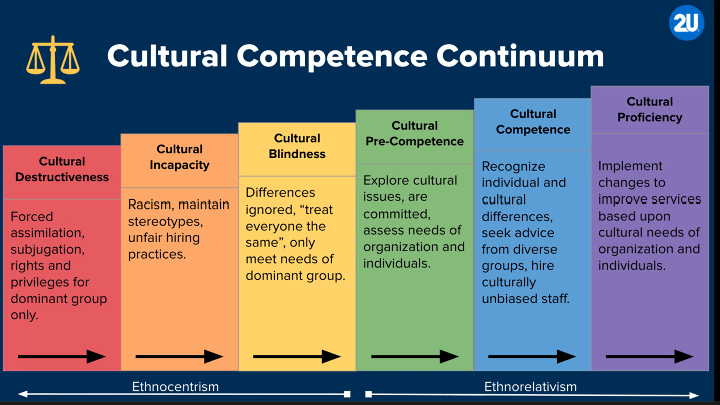
So I learned something there about some of my students and their ability to listen – and it wasn’t good. But I think they learned something too. I think. I am still not sure they weren’t just performing compliance. But I‘d like to think they moved somewhere on the cultural proficiency continuum. Maybe from cultural destructiveness/cultural incompetence towards cultural precompetence. Maybe. If I do this unit again I might foreground that continuum, because I think a lot of the white students really can’t hear themselves. They will say things “about hip-hop” they would never say to Black students in the room about them, but the content is very similar and similarly hateful. Which is actually an opportunity, when handled with care and consideration and accountability, since it helps them overcome the guilt-based silence that is so often the default.
Overall and What’s Up Next
My goal with “Poetic Justice” was to deepen students’ sense of possibility, heighten the sense of tension as it exists between Kendrick’s and Drake’s approaches, and also develop that habit of seeing signifyin(g) – multivoiced, allusive, ironic and complicated rhetoric that is at the same time still intuitive, playful and clever. In the next post I’ll finally get into the beef itself, with 2023’s “First Person Shooter,” by Drake, featuring J Cole.


