
[This post is part 6 of a series on teaching the Kendrick/Drake Beef – click here for part 5 –“First Person Shooter – Rap Beef as Socratic Dialogue”]
Introduction
This post is really, really long. I hope you’ll go on the journey with me. This is one of those rabbit holes that got deeper and deeper wherever I looked. It’s an amazing thing I’m slowly learning about hip-hop – when it’s done well, like I believe it is here, there’s nearly always a history, always chains of reference and allusion – like the traditional diction John Miles Foley has described, the whole of that tradition is somehow present in every part, energized by that fact, and made beautiful because of it.
- “First Person Shooter” – Drake featuring J Cole – 10/24/23
- “Like That” – Metro Boomin featuring Future and Kendrick Lamar – 3/26/24 ← WE’RE HERE
- “7 Minute Drill” – J Cole – 4/5/24
- “Push Ups” – Drake – 4/19/24
- “Taylor Made Freestyle” – Drake featuring AI Tupac/AI Snoop Dogg – 4/19/24
- “Euphoria” – Kendrick Lamar – 4/30/24
- “6:16 in LA” – Kendrick Lamar – 5/3/24
- “Buried Alive Interlude Pt 2” – 5/3/24
- “Family Matters” – Drake – 5/3/24
- “Meet the Grahams” – Kendrick Lamar – 5/3/24
- “Not Like Us” – Kendrick Lamar – 5/4/24
- “The Heart Part 6” – Drake 5/5/24
Five months after Drake and J Cole’s “First-Person Shooter,” we come to “Like That,” a song Kendrick Lamar features on, from Future and Metro Boomin’s album We Don’t Trust You. Prior to then, the beef had not really started. As I wrote about last time, “First Person Shooter” actually doesn’t fire any specific shots, certainly not at Kendrick Lamar, who if anything seems to be named positively. Here are two of J Cole’s rhymes:
Love when they argue the hardest MC
Is it K-Dot? Is it Aubrey? Or me?
We the big three like we started a league
But right now, I feel like Muhammad Ali
Translating this into very straightforward prose, J Cole is saying this:
I love it when people argue about who’s the most talented rapper. They wonder if it’s Kendrick Lamar (K-Dot), Drake (Aubrey) or myself. We’re all great, but I think I’m the greatest (i.e., Muhammad Ali).
That’s not really a diss – it’s more, “we’re all great but I’m slightly better than you.” So before I get into what Kendrick Lamar did to start the beef, I want to share my theory about why this set it off.
What’s Really Going On? An Interpretation of Kendrick Lamar’s Exigence
The rhetorical concept of exigence brings focus to the catalyst for a given rhetorical act. What made it so that the speaker had to speak? Exigence is related to occasion (relevant circumstances immediately before the rhetorical act), and purpose (the goal the author has for the audience), but it’s a little different from both of them. The way I heard another teacher explain it once, it’s, “what’s stuck in the speaker’s craw?”
So, what’s really stuck in Kendrick’s? Obviously I can’t know. But here’s a theory I have. First of all, there’s about 15 years of tension between Drake and Kendrick. I won’t go through all of that (but I highly recommend that video I just linked- it’s very thorough and gave me all kinds of context for what I’m about to say).
I think race has a lot to do with it already – it’s named very explicitly later in the beef, but also, I think is very relevant from the outset. I’m white, looking at an argument between two mixed artist and one Black artist, and that artist isn’t me, so I say all of this with humility and the complete willingness to be wrong but let me make an analogy to another published conflict where the dynamic was really similar.
During a 2022 baseball game at Yankee Stadium, Josh Donaldson (white baseball player then playing for the New York Yankees) called Tim Anderson (Black baseball player then playing for the Chicago White Sox) “Jackie,” clearly referring to Jackie Robinson, first ever Black player in the Major Leagues. Donaldson’s intention was pretty clearly diminutive – basically “you’re obviously not as important as him so I’ll call you that to highlight the distance and make fun of you.” The two ended up in an on-field altercation that cleared the benches. After the fact, here’s how Tim Anderson explained himself:
“He just made a disrespectful comment… Basically he was trying to call me Jackie Robinson. ‘What’s up, Jackie?’ I don’t play like that. I don’t really play at all. I wasn’t really going to bother nobody today, but he made the comment and you know it was disrespectful and I don’t think it was called for. It was unnecessary” (ESPN).
Donaldson’s reply was that Anderson had previously called himself “today’s Jackie Robinson,” which he had (explaining that whereas Jackie Robinson broke the color barrier, Tim Anderson was breaking the “no fun” barrier – as he was known for being more exuberant on the field than the “unwritten rules” call for). Donaldson said it was an “inside joke” because the two were friends, and it had been a joke between the two of them for years. Here’s Anderson’s reply to that:
“In 2019, I know he did. He did say that. I told him that, you know, we don’t ever have to talk again…I won’t speak to you. You won’t speak to me if that’s how you’re going to refer to me. And I know he knew exactly what he was doing because I already told him.”
In other words, Donaldson thought it was a joke, thought they were cool. Anderson did not share that sentiment, and if we take his word for it, had told Donaldson as much. Anderson was angry – very angry – about Donaldson’s assumed friendliness. He went on to hit a memorable 3 run homer in the next game, silencing Yankee Stadium’s chorus of boos, effectively doubling down on his even more memorable bottom of the 9th come-from-behind game-winning homer in the previous year’s “Field of Dreams” game.
In 2023, Kendrick Lamar was in a similar position. J Cole and Drake had assumed a kind of friendship, and then made what would otherwise have been a very mild jab (i.e., yeah you’re great but I’m a little greater). Now, Josh Donaldson is white-white – J Cole and Drake are both mixed. It’s not the same, but the dynamic has some similarities. They’re bringing him into a club he doesn’t want to be a part of, and he seems to take umbrage at their glad-handing inclusion. I’m not saying that J Cole or Drake are “being racist” in this moment – only that race is already on the table, which changes how it lands. That’s what Josh Donaldson seemed not to get. I am guessing Anderson had been relatively understated in telling Donaldson he didn’t like that, and also that Donaldson didn’t pick up on it. I feel like I’ve seen that happen across the white-Black racial line before, in all sorts of conversations.
It’s something I’ve seen and heard about in my classroom a lot. Black students often get roped in as “friends” in awkward situations by white kids, who seem strangely eager to have a multicultural friend-group. Something one Black student – V – spoke on once was about how his white friends had asked him whether, since they were friends, he would give them “the pass” and let them say the n-word around him. He was pretty mad about this, and felt like it was a lot to have to tell them no, they weren’t cool like that. And V was frustrated that he had to spend the energy defending himself in that way.
Or in another related context – you know those “three under a tree” college admissions brochure pictures, where it’s like, a white kid, an Asian kid and a Black kid, even though the institution is prominently white, and the picture is therefore misrepresenting the campus’s inclusiveness? At some level, Drake and J Cole put Kendrick in their brochure, and without his consent.
Long story short, across racial lines, over-familiarity (even through ostensible compliment) can land aggressively. It invokes a whole bunch of problematic history – it’s even something Baldwin identifies as central to American film – the reassurance of Black friendship in the midst of trying circumstances for a white person being a vital American trope.
I think that for Kendrick, after 15 years of mild-to-moderate frustration with Drake, much of us seemingly along just these lines, this was the straw that broke the camel’s back. Because J Cole and Drake weren’t really cool with Kendrick, they were using Kendrick for their own representation of street credibility. And somehow Kendrick felt like the moment was right to get after it.
The Socratic Dialogue Continues – “Is you like that?”
I’ve studied 2-3 of Plato’s dialogues with my AP Lang students for years. This past year, I had an intuition that thinking about how Socratic dialoue works would help me and my students explore Kendrick and Drake’s dispute. One day, one of my white male students – A – seemed to have a crucial insight about why Kendrick’s reply comes in a song called ‘Like That.” He was showing his group members the way Future was questioning Drake’s very sense of self. A repeated refrain in the song is “is you like that?” and the way he read this partially was, “do you [Drake and J Cole] really hold the identity you are representing yourself to have in your music?” He seemed to intuiti that that has a lot to do with representations of Blackness, and class, and masculinity – i.e., being “hard” (i.e., “the hardest MC”). Kendrick’s verse midway through the song goes on to very directly lay out the stakes of faking at that identity, and what the hip hop tradition really should mean instead.
Let’s think about how Future’s verse sets up Kendrick’s. The way a Socratic dialogue works is, first Socrates’ interlocutor uses a morally significant term – for Euthyphro, it’s “piety” – and then Socrates asks an innocent question – something like “piety huh? That’s a complex concept. You sound like you know a lot about that, though I must confess I don’t really know that much. Since you do, tell me, what is piety?” The dialogue develops from there as it turns out that though Euthyphro, or whoever else Socrates is questioning, is comfortable invoking the idea of piety, when he’s asked about what it truly means, he can’t answer coherently. The words Socrates uses in Greek are ‘ti esti?” – “what is it?” That ti-esti question marks the conversation’s shift from casual conversation to philosophy.
This song is doing something similar – it’s clapping back at Drake and J Cole’s casual invocation of a notion like “hard” (and it’s not just that word – but a whole bunch of other attendant representations and postures). It does this by asking repeatedly “is you like that?” asking, implicitly – what is “that” – ti esti? – and how do you know you have it? Kendrick/Metro/Future, like Socrates before them, are not only arguing to be argumentative, not inquiring about moral terms and their definitions: they’re interrogating a whole way of life, a whole identity. and through a repeated rhetorical question, they’re starting a conversation Drake and J Cole, like Euthyphro (or Josh Donaldson) before them, were likely not expecting to have.
The Role of Misogyny in “Like That”
Kendrick Lamar is only a feature on this song – he gets the middle verse (which I have A LOT to say about, and already have explored just a single line). Kendrick’s verse is framed by a first verse by Future, a chorus, then later a chorus and outro. The first time I listened to “Like That,” actually, my Black female student T (discussed in this post about Poetic Justice) told me, “skip over all that Future stuff – yeah find the Kendrick verse…” So that’s what I did. And for a long time, that’s how I left it. It seemed like a pretty shallow song overall – again, about women, sex, money, but there was this really deep verse (Kendrick’s) in the middle.
But this past year, after A shared his analysis of this song, I now think the whole song is more intentional than T and I initially thought. I’m not super-duper confident about my reading of Future’s verse, especially because it requires me to go through what might seem like contortions to explain away what on its surface looks like straightforward misogyny, but I’m taking my lead from readings of other similar moments that Black female students and scholars have encouraged me to reconsider. So if what follows feels like a reach, I feel that too, but I don’t think it’s totally out of left field either. Anyway, here goes:
Here’s Future’s first verse:
Stickin’ to the code, all these hoes for the streets
I put it in her nose, it’s gon’ make her pussy leak
Pussy ns told, ain’t gon’ wake up out they sleep
You can’t hear that switch, but you can hear them scream
All my hoes do shrooms, n****, all my hoes do coke
Twenty-carat ring, I put my fingers down her throat (Uh, uh, uh)
If I lose a carat, she might choke (Uh, uh, uh)
I know she gon’ swallow, she a GOAT (Uh, uh, uh)
Freeband n***, bring the racks in
Got the shooters in the corner like the pack in
She think ’cause she exotic b****, she attractive
That’s that shit’ll get you put up out the section, brrt
And the motto still the same
Ball like I won a championship game
You know these hoes hungry, they gon’ fuck for a name
I put her on the gang, she get fucked for a chain
Got your girl in this b****, she twirlin’ on the dick
I got syrup in this b****, turn up in this b****
And we brought the ‘Ercs in this b****, get murked in this b****
All these pointers on me, baby, you know it’s game time
Bring a friend, b****, we fucked ’em at the same time
I’m a different n****, no, we not the same kind
You can have that lil’— if she ain’t mine (Yeah)
Now the first time I heard this verse I didn’t really think there was that much to it, not so creative, basically all “I’ve got all these women to have sex with me because I’m such a big shot,” and enumerating that in pretty foul and objectifying ways. That’s clearly there. BUT – the reading I want to suggest is that what’s going on is playing with that idea, in Gates’ sense, signifyin(g) on it, specifically as a vision of what makes someone “like that,” and putting it out there, even performatively embodying it, as a way to come after Drake for insincerely adopting it.
Three sources I will cite about that – one – Imani Perry’s argument in Prophets of the Hood, her 2004 book about hip hop. Perry argues that hypermasculine posturing by male rappers is at least partially about controlling a stereotype the public already holds about them -a kind of ironic (or at least strategic) overidentification that protects itself from male racist control by using the spectre of misogyny to critique a broader racist structure. Basically, “you already see me like this; let me control its terms by building it into my art.”
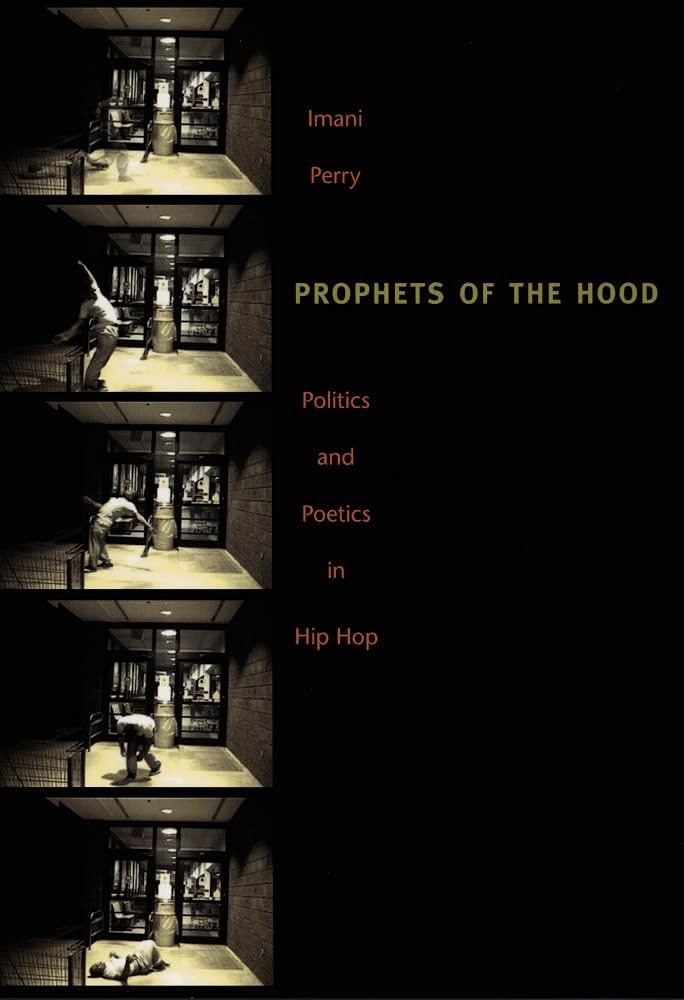
“To speak about gender relationships in hip hop is to speak about identity formation in the hip hop narrative. As I said before, hip hop as an art form is gendered male, despite the presence of some excellent female artists. And because, like race, gender is a category shaped through opposition, women prove fundamental to constructions of masculinity in hip hop. Regardless of its location within a folk tradition, the sexism in hip hop has been roundly critiqued, and yet the very existence of this critique constitutes a central feature of the badman tradition since his is a social role construed as antithetical to being a ‘credit to his race’ in any way” (Imani Perry, Prophets of the Hood, 129)
That last sentence is one I had to think about a lot. Ther, what Perry is arguing, I think, is that the sexism critique about verses like Future’s isn’t irrelevant or false, and it’s not “ironic” in the sense that no sexist representation is being affirmed at all through these lyrics, or that Future is “only joking.” The truth of the sexism accusation doesn’t mean that there’s nothing meaningful going on in the song behind that, or that it needs to be cancelled. The first verse deploys sexist jokes partially to explore how the public sees Black men, embracing that vision to create what Perry identifies as the “badman” posture and also, I will argue later, to critique Drake for trying to act “like that.”
Another source I’ll cite here is students of mine – Black female students over the course of several years, who have responded skeptically to accusations that this or that Black male hip hop artist is misogynistic. I remember one – K – when asked about this in relation to Kendrick Lamar’s “For Free?”, in which he seems to tell off a nagging golddigging girlfriend (which upon further reflection turns out to be a very clever metaphor for the way the United States treats Black labor). When I asked her about the way Kendrick was treating this woman, K barely hesitated, looked me dead in the eye and said “I know Kendrick respects Black women.” Another Black female student – D – read a line from “Hiiipower” – “fire in between the legs of your little sister” as Ab-Soul acknowledging how young Black women are seen, not trying to see them like that. A third Black female student – J – read Drake’s focus on “your big ass in that sundress” (from “Poetic Justice”) as him calling attention to aspects of Drake’s love-interest’s body that are generally denigrated by mainstream white society, not objectifying her. I’m not saying all those readings are right. Nor am I saying “they’re Black, they said so, they’re right,” but I am wondering if there is a kind of subtlety that those Black female students of mine are noticing (and that my white students seem not even to consider) – a kind of cultural literacy about speech like this that these students of mine have acquired – that lets them hear more than the misogyny (not by ignoring it, but by feeling a more complex context). I think they may be voicing something similar to what Perry is parsing academically. This also ties in with Gates’ idea of two-voicedness of signifyin(g)- Future’s verse is both using sexist tropes AND commenting upon them; it does not resolve cleanly into one or the other.
The third source for some support for this reading is from Kendrick Lamar himself. Before the beef, on his 2022 album Mister Morale and the Big Steppers, he explores this kind of racialized misogyny in great depth and brutal vulnerability for somewhere close 90 minutes of music, especially on songs like “Father Time” and “Mother I Sober,” both of which explore gender in the context of race, and in the context of his own family. And that was all recorded before “Like That.” Also later in the beef itself, he very directly, explicitly and with minimal irony accuses Drake as follows in “Meet the Grahams”:
He hates Black women, hypersexualize ’em with kinks of a nympho fetish
Grew facial hair because he understood bein’ a beard just fit him better…
I been in this industry twelve years, I’ma tell y’all one lil’ secret
It’s some weird shit goin’ on, and some of these artists be here to police it
They be streamlinin’ victims all inside of they home and callin’ ’em tender
Then leak videos of themselves to further push their agendas
I don’t think an artist who records Mr Morale, or this verse would be willing to perform on a song that’s straightforwardly and un-ironically denigrating women. But still, the lyrics are what they are. I think it’s really complicated and worth exploring.
Future’s Verse – A Fraught Take-Down
With all of that in mind, let me explore the verse. After a Socratic dialogue’s initial phase, where an arrogant interlocutor holds forth in all their arrogance, and then Socrates poses the vital “ti esti” question, the next step is called the elenchus – which I’ve seen translated as “destructive cross-examination.” The first verse of “Like That,” and then the chorus do exactly that – destructively cross-examine Drake and J Cole.
My fundamental argument is that the verse is setting up a criticism of Drake as inauthentic, as someone who uses sexist posturing, racial stereotyping and drug-dealer street lingo to represent himself as something he is not – Perry’s “badman.” A rapper like Future draws on the badman to take control of a stereotype that controls him, but Drake is just exploiting it, colonizing it, appropriating it for profit, and that’s subtly but crucially different. The verse is an effort to force Drake’s fans to reconsider that posturing and their own relationship to an artist acts “like that” – and a broader inquiry into how “that” works in the industry more generally.
The song starts with a sample from “Everlasting Bass” by Rodney O and Joe Cooley. It’s where the horns and the bass line come from, which Kendrick notes later on.
Stickin’ to the code, all these hoes for the streets
I put it in her nose, it’s gon’ make her pussy leak
Pussy n****s told, ain’t gon’ wake up out they sleep
You can’t hear that switch, but you can hear them n****s scream
Future pivots cleverly between two uses of “pussy” – through anadiplosis (use of a word or phrase at the end of one clause and the start of the next). The first “pussy” is used like we’d expect from the badman – something about how he can give his girlfriends coke and how that will turn them on. Fine. Like I said, not too deep, seemingly offensive in a straightforward way. But the second “pussy” – “pussy n***’s told…” pivots from his bad-man treatment of women to an indictment of rival MCs’ failures to realize what’s happening when he’s rapping, why he’s better than them. It does this by using a cluster of terms that describe both physical violence and lyrical prowess – “switch” referring both to a silenced gun he’s pulled before they can hear it, but also, a beat switch, a rhythmic pivot within a song that they can’t appreciate musically. “Screaming” then means both being wounded from a literal shooting but also a metaphor for the musical success that they can’t understand – all they hear is the crowd response (screaming) but not the internal logic that set it off (the switch). And not coincidentally, Drake has some widely reported drug problems that also get discussed more thoroughly later on in the beef. Essentially, Drake is one of the “pussy n***’’s so named – the stereotype of the woman being described as subservient is doing double duty also as a vision of the reality of Drake’s existence.
All my hoes do shrooms, n****, all my hoes do coke
Twenty-carat ring, I put my fingers down her throat (Uh, uh, uh)
If I lose a carat, she might choke (Uh, uh, uh)
I know she gon’ swallow, she a GOAT (Uh, uh, uh)
Again, more about all the golddigging women he’s got strung out and worshiping him. Again, problematic, yes. But also, I think there’s arguably an underlying joke about “GOAT” that comes at Drake directly. Remember that in “First Person Shooter” Drake repeatedly asked “who the GOAT?” So just like in the first four lines, Future compares his women to his less-talented rivals, here, GOAT had three meanings – goats eat anything, also she’s the “greatest of all time” because she swallows (again, problems), but last, “she a GOAT” suggests something about Drake – that he’s a golddigger drug-using less talented MC – a “goat” in a sense totally opposite what he claims when he uses the same word. Think about the “First-Person Shooter” single cover art:
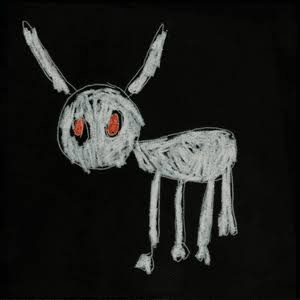
When this song plays with “GOAT” it’s alluding to Drake and J Cole. You can continue that argument with the later words in the verse, but let’s look at the final couplet:
I’m a different n****, no, we not the same kind
You can have that lil’— if she ain’t mine (Yeah)
That’s where the base idea of “Like That” comes back up – as Future establishes distance between himself and some other kinds of people. I think the main gap here is between rappers like Future, Metro and Kendrick on the one hand, and Drake and J Cole, on the other. And just like they can get with Future’s lesser women, they themselves are lesser for similar reasons.
The Chorus and Its Sample – the Aporia
A next step in the flow of a Socratic dialogue is the “aporia” – the fog, the cloudiness – the moment when the interlocutor begins to accept their lack of knowledge at a deeper level. The chorus takes everything that’s been implied so far in the elenchus phase and makes it more explicit, and more emotionally impactful though epistrophe and then the hip-hop’s best and most distinctive move – the sample:
Young dope dealer, sellin’ dope, is you like that? (If you like that)
Kickin’ doors, kickin’ in doors, is you like that? (Yeah)
Young throwed n****, sellin’ loads, is you like that? (Yeah)
All ’24, you on go, is you like that? (If you like that)
N****s from the bottom really like that (If you like that)
Steppin’ in Balencis if you like that (If you like that)
Pop another bottle if you like that (If you like that)
Tthe clause “if you like that,” through epistrophe (repetition at the end of successive clauses) helps the chorus develop what was only alluded to before – an explicit image of all the things that Drake is not. He’s not a “young dope dealer sellin dope,” he’s not “kickin in doors…” nor “sellin’ loads” etc. etc. And I think the phrase “n****s from the bottom” identifies Drake more directly, being a huge catch-phrase from a 2013 Drake hit:
As has been well documented, Drake is not really “from the bottom.” He grew up in middle class Toronto, first finding success as a child actor on DeGrassi Junior High. His father is a successful Black session musician, and his mother is a white Jewish English teacher. As his father reports (and Drake seems to acknowledge in the video below), Drake adopts that persona because ‘it sells.”
I want to be careful here though – I’m not saying that the problem is that Drake wasn’t poor or isn’t really Black. I think this is something Kendrick explains later on “Euphoria” and “Meet the Grahams” – the issue is not his identity per se but the way he uses visions of others’ identities that are not his. Rather than that bad man framing that Future is playing on strategically as a means of managing a narrative that is placed onto him by a general public, Drake is exploiting the fact that it’s placed onto others – and reveling in that exploitation – to make his own hay with it. People don’t see him “like that,” and he’s got a kind of privilege that means he’s not really reclaiming anything, but taking cultural energy that exists around someone else’s identity to sell records, and also to reinforce the underlying image onto those others. Which puts him much more in league with Elvis Presley, say, than Eazy-E.
Speaking of Eazy-E, the hook at the end of the chorus really deftly draws in the West Coast tradition:
He was once a thug from around the way
That is sampled almost wholesale from Eazy-E’s “Eazy-Duz-It”, maybe by way of The Game and Kanye’s “Eazy”
By drawing in Eazy-E (the deceased original third member of the groundbreaking west coast group NWA) we’re also brought into the whole west coast pantheon – Dr Dre (NWA’s primary producer) and from there to Dre’s collaborator Snoop Dogg (both of whom make cameos on Kendrick’s 2015 To Pimp a Butterfly, and the latter of whom Drake very oddly decides to AI-simulate later on in the beef, on “Taylor-Made Freestyle”). Beyond the allusion to its creator, the sample also does something musically I’ll try my best to articulate – before it plays fully, the track lets you you anticipate it harmonically, because the first part, or at least the music underneath the “he was once a…” part hangs in the background by repeating, unresolved, while we hear all the other repetitive lines in the chorus – then it finally resolves harmonically when the loop plays out – “he was once a thug from around the way.” When it finally lands, it uses that harmonic resolution to draw the lyrical content of the chorus into the sentiment of the sample itself. The sample establishes an actual pedigree to contrast with Drake’s “from the bottom” hyped persona. My student A explored this a bit – ‘he was once a thug from around the way,” he read as, even if Drake was at some point, he’s not now. I would go further – I’d say this is an entirely ironic sample – it’s mocking Drake by saying the opposite of what he is. The sped-up Chipmunkization of the sample playfully invokes that – it’s a childish playing at thuggishness that we hear, designed to make us realize emotionally that no, Drake never was “a thug” or “from around the way” by reminding us of the genuine article – Eazy E and NWA, who, along with Tupac Shakur, are really serious forefathers to Kendrick that he’s paid his respect to on nearly every album. For Tupac, “thug” was a reclaimed term of art.
Kendrick’s Verse – The Next Step in the Dialogue – How to Really Be The GOAT
For Plato/Socrates, after elenchus and aporia comes dialectikos – dialectic – positive cross-examination: the direct argument, not about what the interlocutor is wrong about, but what, now that they’ve acknowledged that they know nothing, the thing they’re now in a position to learn. Kendrick’s verse is that direct knowledge – what it really means to be the GOAT, and why. It’s not asking questions, it’s making statements. Now, Drake has definitely not admitted that he knows nothing, so the analogy breaks down a bit – I think it’s more Drake’s fan-base that’s more likely to feel that disorientation and consequent learning. Later on in the beef, Kendrick does address Drake very directly, seemingly pleading with him to hear this – but for now, it’s a less direct dialogue.
I’ve already explored Kendrick’s verse at great length here, so I’ll try to consolidate rather than re-letigate. But let’s start here: on 2015’s “Hood Politics” Kendrick rapped “it’s funny how one erse can fuck up the game,” and he was then talking about his verse on Big Sean’s “Control,” which called out a number of rivals, among whom Drake – but that “Hood Politics” line applies, I think, even more to this right here, which in 2024 was nothing short of a pop-culuture nuclear detonation, and without which I don’t think the purpose of Future’s purpose would really come out so clearly:
These ns talkin’ out of they necks
Don’t pull no coffin out of your mouth, I’m way too paranoid for a threat
Ayy-ayy, let’s get it, bro
D-O-T, the money, power, respect
The last one is better
Say, it’s a lot of goofies with a check
I mean, ah, I hope them sentiments symbolic
Ah, my temperament bipolar, I choose violence
Okay, let’s get it up, it’s time for him to prove that he’s a problem
Ns cliquin’ up, but cannot be legit, no 40 Water, tell ’em
Ah, yeah, huh, yeah, get up with me
Fuck sneak dissin’, first-person shooter, I hope they came with three switches
I crash out like, “Fuck rap,” diss Melle Mel if I had to
Got 2TEEZ with me, I’m snatchin’ chains and burnin’ tattoos, it’s up
Lost too many soldiers not to play it safe
If he walk around with that stick, it ain’t André 3K
Think I won’t drop the location? I still got PTSD
Motherfuck the big three, n****, it’s just big me
N****, bum
What? I’m really like that
And your best work is a light pack
N****, Prince outlived Mike Jack’
N****, bum
‘Fore all your dogs gettin’ buried
That’s a K with all these nines, he gon’ see Pet Sematary (Yeah)
N****, bum
When I played this verse in my classroom, even two years after its release, the excitement was palpable, even in a largely reserved, mostly white AP Class. That emotional charge, I think, comes not only from its rhythm and its flow, but its brutal verbal efficiency. Let’s step into it:
These n****s talkin’ out of they necks
Don’t pull no coffin out of your mouth, I’m way too paranoid for a threat
Ayy-ayy, let’s get it, bro
Kendrick starts by referring to Drake as pluralized “n****s,” as a way to reduce Drake (by refusing to name him) and generalize the argument (by selecting a term with a wider potential denotation). Here, maybe it’s J Cole and Drake – and what are they doing? “talkin’ out they necks,” i.e., saying things that make no sense, lying, exaggerating – all the things Socrates reveals about Euthyphro. I think the underlying sense of “talking out of one’s neck” might be, talking without using your head, talking like you don’t have a head, just a neck. “Coffin” calls back to Drake’s second line in “First-Person Shooter”- “turning your song into a funeral” – like, don’t talk like you’ve killed anybody, literally (because you’re not “like that”) or metaphorically (because you’re not good at rap) – also the play with mouth/neck, and coffin/coughin’ (i.e., speaking inarticulately) establishes right away, not only does he think they’re speaking nonsense, but also that it’s got nothing musically either. “I’m way too paranoid for a threat” genius.com connects to some Tupac lyrics about paranoia. When Kendrick says “ayy-ayy- let’s get it, bro” what I hear here is, something like “you weren’t looking for trouble? Well, trouble found you.” He’s not interested in what Drake or J Cole meant, he’s interested in starting a fight regardless.
D-O-T, the money, power, respect
The last one is better
Say, it’s a lot of goofies with a check
As far as I’m concerned these are the lines, the centerpiece of the entire beef, and the line that Drake never shows even a glimmer of understanding about, much less makes a coherent reply. Real quick, here’s what I, my students and/or genius.com see:
- DOT – K-Dot, Kendrick’s generally-earlier-career nickname
- Allusion to D-DOT – one of the producers of the song “Money, Power Respect”
- Reference to “Money, Power and Respect” itself, a 1998 song by the Lox (but without the “and” – which is asyndeton)
- An implicit reformulation of the argument of that song – Lil Kim begins “See I believe in money, power, and respect. First You get the money. Then you get the muthafuckin, power. After you get the fuckin’ power muthafuckas will respect you.”
- “The last one is better” meaning “respect is more important than money or power” in determining who’s the GOAT
- Oblique reference to Kendrick’s earlier “Backseat Freestyle” – “All my life I want money and power, respect my mind or die from lead shower” highlighting that same value reformulation
- D O T as Dreamville (J Cole’s label), OVO (Drake’s label), T as Top Dawg, Kendrick’s label
- A resultant triple comparison – D:money::O :power::T:respect, and since “the last one is better,” Kendrick, Top-Dawg and respect all come out on top of the other halves of the analogies.
- “It’s a lot of goofies with a check” as a clear argument about why Drake’s implied criterion – wealth – is pointless. Because you can still be a “goofy” and have “a check.’ Even implied a little bit is that if you are rich, it’s a good reason to be suspicious.
Putting all of that together, Kendrick’s words here refute Drake’s idea of GOAT-ness as individual wealth, success with women, and replaces that with a different vision – paying homage to the tradition that made you, acknowledging your place in a collective. This is his thesis statement: being the GOAT is not about your individual success, but how much you do for your community. Plenty of people find individual success, including Drake and J Cole, but plenty of those people are morally suspect. It’s not even about receiving wealth vs receiving respect (which is more or less what Lil Kim had rapped about), it’s about the difference between receiving vs. giving in itself. So, I think Kendrick is saying, to be the GOAT is not to receive any accolades at all, but it’s about doing right by your ancestors – giving respect to the tradition. Which, in a really eerie way, is almost literally what Socrates and Euthyphro’s argument turns on. Euthyphro seems being pious as being “pleasing to the gods” – impressing them with your behavior, and he thinks he’s right because others acknowledge this in him; Socrates argues instead that piety means the science of living respectfully towards the gods, and he doesn’t fully know he’s right for any external reason – he knows this because his conscience tells him so.
I mean, ah, I hope them sentiments symbolic
Ah, my temperament bipolar, I choose violence
Okay, let’s get it up, it’s time for him to prove that he’s a problem
N****s cliquin’ up, but cannot be legit, no 40 Water, tell ’em
Ah, yeah, huh, yeah, get up with me
This passage is more straightforward – he’s thinking wow, I hope Drake isn’t literally so mad about not getting Grammy recognition and “flowers” (“I hope the sentiments symbolic”). In calling himself “bipolar” he may also be referring to his own struggles with depression, and that even if Drake is perhaps being melodramatic, he’s still going to “choose violence” – lyrical violence – right here. “It’s time for him to prove he’s a problem” – it’s time for Drake to prove he’s “like that” (implicitly saying, he won’t be able to do that). “40 water tell ‘em” calling attention to a sample between this song and E-40 aka 40 water’s song “Look at Me” – which song’s chorus asserts “I’m like that… it’s like that”- that mutually sampled song being “Everlasting Bass” by Rodney O and Joe Cooley (which song also contains the line “he’s Black not Jewish”) – it’s the horns and bass line that introduce the song. So Kendrick’s “cliquing up” again by drawing on the west coast songs that let himself, Future and Metro build this very song.
Fuck sneak dissin’, first-person shooter, I hope they came with three switches
I crash out like, “Fuck rap,” diss Melle Mel if I had to
Got 2TEEZ with me, I’m snatchin’ chains and burnin’ tattoos, it’s up
Lost too many soldiers not to play it safe
If he walk around with that stick, it ain’t André 3K
Think I won’t drop the location? I still got PTSD
Kendirck’s not interested in subtle confrontations, but instead a full frontal attack (again, punning on “switches” like Future did). The overstatement if dissing Melle Mel (an even older hip-hop OG) emphasizing he has no problem going after Drake. “With that stick” refers to J Cole’s song “Stick,” where he asserts his hardness by emphasizing that he carries a gun in his car – tying in also with Andre 3K (of Outkast fame) who carries not a gun, but a flute – who has earned the right really to be “like that,” as opposed to what Kendrick is reading as J Cole’s fake posturing. And “Think I won’t drop the location” and “I still got PTSD” can very well refer to Kendrick’s own child-sexual-abuse adjacent exploration of his own trauma on “Mother I Sober,” (an exploration Drake later misunderstands on “The Heart Part 6”) and ‘Think I won’t drop the location” is arguably a threat Kendrick carries through on the later cover art of “Not Like Us,” alleging most direct that Drake is a pedophile.
Motherfuck the big three, n****, it’s just big me
N****, bum
What? I’m really like that
And your best work is a light pack
N****, Prince outlived Mike Jack’
N****, bum
‘Fore all your dogs gettin’ buried
That’s a K with all these nines, he gon’ see Pet Sematary (Yeah)
N****, bum
“Motherfuck the big three, n****, it’s just big me” – this was the soundbite, but it’s not just that. And no one listening heard anything less than exactly what it says. I do not want to be any part of your “big three.” I am not your friend. I am bigger than you and we do not belong on the same stage. This directly responds to J Cole’s – “we the big three like we started a league, but right now I feel like Muhammad Ali.” That’s playful – we’re all good but I’m better. Kendrick’s “three/me” rhyme highlights the refutation with very direct efficiency, ready-made to be re-tweeted. “I’m really like that” reaches back to the song’s chorus and its title in a new rhythmic context, affirmatively saying, that thing you think you are, I really am. “Your best work is a light pack” expertly modulates via assonance then rhyme, getting him from “like that” to “light pack” to “Mike Jack.”
What follows becomes a beef-long thread. Recall that on “First Person Shooter “ Drake said he was “one away from Mike, N*** beat it” – he had one fewer number one hits than Michael Jackson, one of which was “Beat it” Kendrick’s response? “Prince outlived Mike Jack” – Prince did, in fact, live longer than Michael Jackson, and Kendrick here aligns himself with Prince (who himself had a career long feud with Michael Jackson) – and who was arguably artistically more creative, factually shorter, aesthetically more experimental, known to be more introverted, and focused on respect for the tradition, rather than Michael Jackson, and we can then see immediately why Kendrick was glad to accept Drake’s comparison- Michael Jackson was notoriously fame-obsessed, wanting-to-be-white, constantly seeming to chase the zeitgeist rather than creating it, and of course, accused of child molestation. That last one develops slowly over the next several songs, reaching its peak at the Super Bowl when Kendrick Lamar somehow got 50,000 people to sing along with “A Minor.” “For all your dogs gettin buried” refers what was then Drake’s latest studio album For All the Dogs “gettin buried,” that is, being killed, destroyed, losing. “Thats a K with all these nines” meaning K for Kendrick, nine for guns, but also canines, i.e., dogs, and then “he gon’ see Pet Semetary” as a pretty decent referential punchline – Stephen King’s novel title and arguably the Ramone’s (“I don’t want be buried… in a pet cemetery”) signifying where Drake is headed.
To cap all that off, we get a wonderful encapsulating onomotopia:
“N*** bum!”
When I played that in my class, I saw a student just hit their desk. As of to say, period, end of sentence. Kendick has left the building. Just compare this for a moment to Drake’s lines “N*** beat it” – which sounds reasonably cool when you first hear it. Then you hear Kendrick’s response: “N**** Bum” – and now Drake sounds corny. Drake’s drawing on one of the more obvious pop-culture allusions possible, with two syllables, and Kendrick’s basically coining his own, with one.
The rest of the song largely repeats the same – the chorus lands again, and we get an outro that reprises the first verse’s content – maybe T was right: it really is all about Kendrick’s verse. But I do think it’s right to say, it’s not out of nowhere – Future, Kendrick and Metro built a Socratic dialogue into a pop song that’s still catching enough that it can work on both levels very deftly. In polling, this actually turns out to be the most liked song in the beef, and maybe that’s why.


