
O muse, sing through me the ways of Musk’s failures, and the confusions upon which they rely…
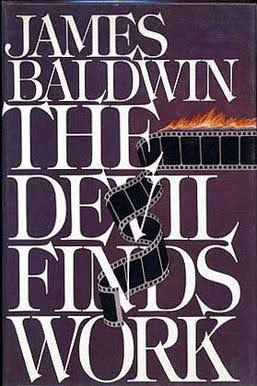
Let me start by saying something I think some of Musk’s critics are wrong about. A predictable kind of social media smugness often emerges in these situations and reads something like “imagine caring about whether a fictional character’s depiction is historically accurate!” As good as that feels to post— of course people care. You don’t need to have read James Baldwin’s The Devil Finds Work to know that representation does politically impactful emotional duty. Just try reading a 4 year old a bedtime story without doing the “right” silly voice. People (from 4 years old on up) have strong opinions about who is depicted how and basically always have. Plato devotes chapters to related topics in The Republic.
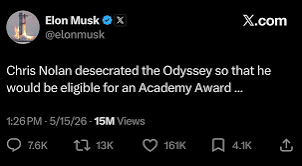
I’m here for the argument, and also, I think Musk is wrong, and I think it matters why. Long story short, his choice of the word “desecration” is really interesting in this context – I’ll come back to that later. I think Musk’s word choice is right, or at least revealing (just in ways he doesn’t realize or intend). It shows us something about how he sees the Odyssey – the role it plays for him – but it’s not just Elon Musk. I think this movie likely provokes a lot of people’s internalized perceptions about Homer’s epic. Nolan’s movie does a relatively subtle job contesting a wrong-headed vision of “classical education.” Even if “subtle” is not the word I’d use for the movie in general, or Nolan’s work in general.
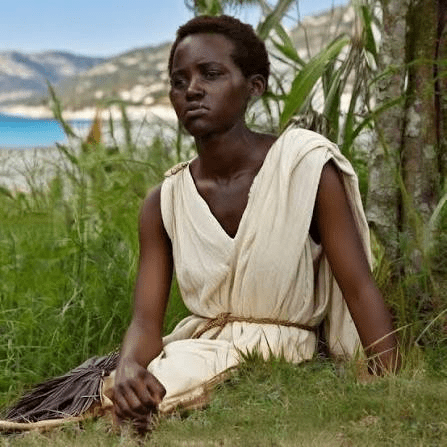
What Musk is mad about, apparently, is the casting of Oscar-winning actress Lupita Nyong’o as Helen – of course, because she’s Black, and apparently Helen was not “really Black” but “Greek” (as if there would have been no one with higher melanin content living in the Mediterranean back then – as if there isn’t now). But don’t worry, it gets worse! She also plays Helen’s twin sister Clytemnestra. Either way, the two characters occupy the screen for maybe 5 minutes of a 3+ hour film. And a far as racial politics of the casting goes, I think this is really a misfired shot. The casting in general is multicultural in about the way a post-2020 Chase ad with a biracial family is. And it’s almost all white men with somewhat exoticized women of color as romantic partners or advisors. No, this movie isn’t “woke.” It’s mostly the kind of centrist focus-grouped politically neutral thing I expect from massive Hollywood releases. That shouldn’t be surprising and it’s not really a problem to me – Homer’s Odyssey is pretty down-the-middle politically too. It’s more of a sign of our times than anything radical in the original that it takes a mild but consistent stand against xenophobia and mistreatment of immigrants and refugees, which is very much integrated into the common sense of the Odyssey, the Christian Bible, the Torah, the Koran and pretty much any other significant sacred or profane text from anytime ever.
“Homer” as a Metaphor for Oral Performance
I actually think a much more interesting casting decision, one it’s easy to overlook, is Travis Scott as Phemius, the bard who performs for the suitors at Odysseus’s home in Ithaca. And I do think in a very literal way this decision does “desecrate” Homer, if by “Homer” you mean the vision of classical education that often accompanies it in American secondary educational spaces. The ones that see Homer as part of a canon, along with Plato, Aristotle, Shakespeare, Dickens, Fitzgerald, you name it.
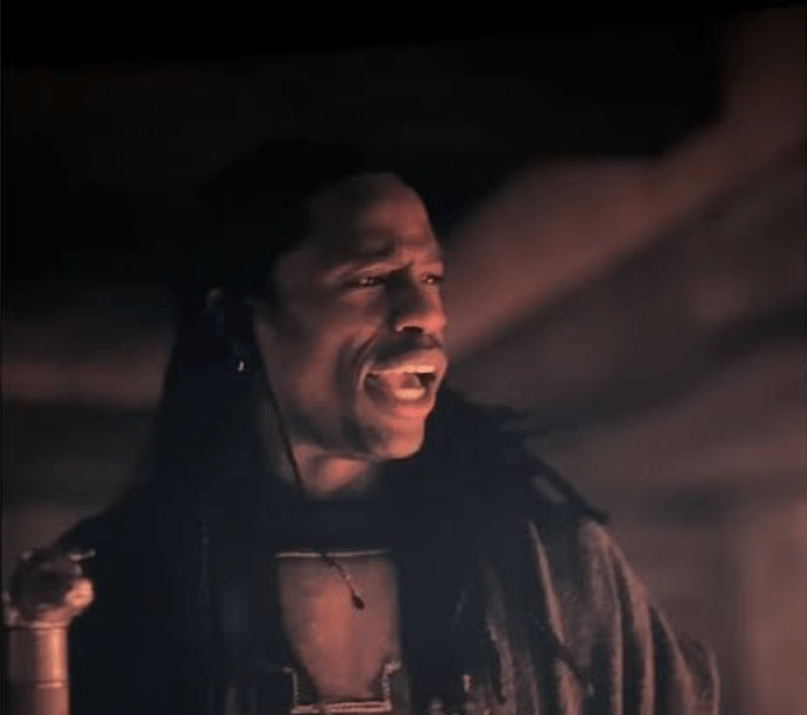
Hip-hop the one of the closest things we have to the Homeric epic performances, both in the way they were performed and in the role they played in their original contexts. And as big of a fan as I am of more “conscious” hip-hop (I’ve written tens of thousands of words about Kendrick Lamar and Mos Def/Talib Kweli’s Black Star album) – Travis Scott, a more popular-appeal, spectacle-chasing rapper, strikes me as just right in a way I wouldn’t have thought before I realized it was him (which was, to be fair, only when I watched the credits). After the headliner stars, when the “Cast in Order of Appearance” rolls, it just says
Bard Travis Scott
Let’s talk about “bard.” That’s the traditional translation for the Greek “aoidos.” You may have been told by your high school English teacher that “in fact, Homer was a blind bard.” This is one of those authoritative pronouncements that is much more complicated (and less true) than it sounds. That factoid is usually traced to the description of another bard that appears in the Phaeacians sequence (omitted from the movie), named Demodokus. Demodokus, the character, is described as blind. In reality, scholars know very, very little about “Homer” and agree about less. But a huge prevailing trend in scholarship since the early 20th century reads “Homer” more like a shorthand for a community of aoidoi (plural) who created and performed the stories we now call The Iliad and The Odyssey. A big idea is that the epic poems we have are more like transcripts of oral performances sung by a widespread tradition in ancient Greece, culminating in Athens a few hundred years after the stories are supposedly set.
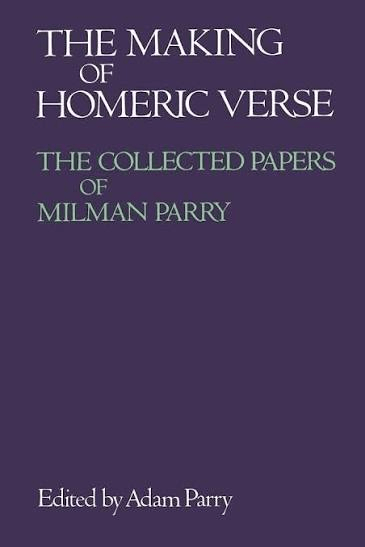
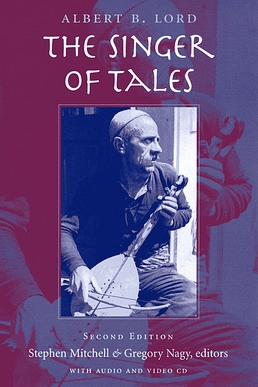
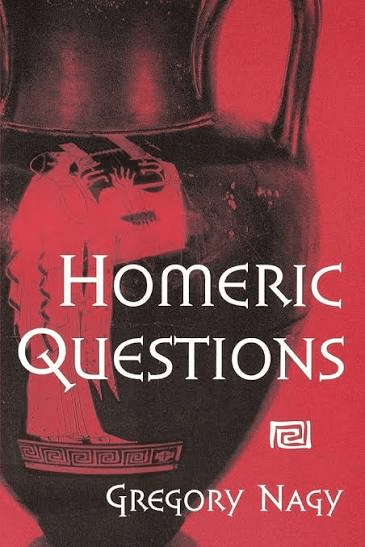
The core idea is that these poems were created as “composition in performance” by illiterate or semi-illiterate aoidoi who were extraordinarily skilled at improvisational and memory-aided story-telling. They didn’t “memorize” long poems and “recite’ them – though later on in the history, many scholars think, there were performers who did that, which generally get called rhapsodes. On this view, the community that produced the Homeric epics were doing much more like what we see Scott’s bard doing in the film at least twice: freestyling a story, aided by rhythm, for an audience who is willing to shout him down, or cheer him on, depending on how they feel about what he’s doing. And that is almost exactly the rhetorical situation that created hip-hop in the Bronx in the 70s. And just like now, 50 years later, there are hip-hop albums and rappers who memorize lyrics that preserve and in a way “canonize” hip-hop, so by the 5th/6th century canonical written recordings of “Homer” were generated and began to circulate. Drawing on the fascinating anthropology and language field work done in the former Yugoslavia by Milman Perry and later Alfred Lord in the 1930’s (and aided by the new invention of reel to reel audio recording) Gregory Nagy (still working at Harvard) has written fascinating books and articles about the oral-poetic origins of and thematic presence in Homeric epics. Nagy’s central claim is that these canonical forms emerged out of performance competitions for the Panathenian festival (a kind of cultural Olympics). As great performances emerged, writing was just becoming more critically possible and cheaper, so there was a desire to write them down, and over time the festival transformed from something more like a freestyle contest to something more like a poetry recitation contest. Once canonical versions emerged, that earlier tradition was displaced, and the tradition of “Homer’s Odyssey” began.
My guess is that Elon Musk doesn’t like Travis Scott, or Kendrick Lamar, or Grandmaster Flash for that matter – he likely sees them as evidence of the inherent inferiority of non-white cultures. He makes explicitly racist statements all the time. But – he thinks – Homer is different. Homer is what the west should aspire to – and here is Christopher Nolan “desecrating” him and his works. Little does Musk know that “Homer” was likely never Homer in the first place. “Homer” was likely a name for a group of relatively anonymous, not-that-formally-educated oral composition poets whose work was later rolled into nationbuilding mythology. Both a Greek nationbuilding mythology, as Athens came to its position of imperial leadership, and then later, 19th and 20th century British nationalism and imperialism, and a 20th century vision America wanted to have as itself part of a lhigh culture.” I don’t think it’s crazy to say that “Homer” is a cultural appropriation, maybe a little like Uncle Remus as the fictional teller of southern folk stories: a back-formed name for a tradition that isn’t actually traceable to a single person. We know that “Uncle Remus” stories were collected and “canonized” by a white curator named Joel Chandler Harris, and we can speculate about why he did that. Whoever collated “Homer” is lost to history, on this view, but that doesn’t stop classicists from speculating about how, when and why this happened.
The idea is that “Homer” is a consolidation of traditional stories improvised in working-class amateur contexts over hundreds of years. The word “Homer,” according to one etymology Nagy showed me, is “joiner” – “Homer” is a collection of a whole range of traditional stories. These epics are not the “foundation” of something called “western civilization,” created by a singular poetic genius – they are a set of rhythmically narrated popular stories that drew on material that was already ancient TO THEM. They’re “retellings” all the way down. The story of the ogre in the cave, the husband returning long after war, the witch who turns men to pigs, the man who visited the underworld— these are all age old tales. Homer represents their “joining” together into two bigger story sequences. Maybe a bit like the WPA work projects that collected African American spirituals or bluegrass songs, and published them in single volumes.
The Odyssey Critiques Readings like Musk’s – If You Know How To Listen
None of that is “for sure,” but given the almost total lack evidence for a historical “Homer,” it’s something classicists have found is actually really productive when it comes to understanding how the texts work and why. In fact, beyond the mode of the Odyssey’s composition, a huge theme in the stories, not coincidentally, is the role that improvised storytelling, and the ability to both manipulate and understand it, can play in a way of life. Like Marshall McLuhan famously said, “the medium is the message.” The Odyssey, on this view, is an orally composed poem, later written down, that is especially concerned with the modes of oral composition in an age where writing was just being invented. You can see this in the manuscript versions of the poem’s first half-line:
ἄνδρα μοι ἔννεπε, μοῦσα, πολύτροπον
Which translates roughly to:
Sing to me, muse about a man of many turns
Note that just like Nolan’s credits say “bard,” and not “Phemius,” this line doesn’t name Odysseus. He’s not even named for the first ten lines. But my favorite word here is “polutropon.” We can split it into recognizable parts that have English cognates. “Polu” comes over into English as “poly-” and means “many,” like a polygon, polygamy, etc. “Tropon” is related to the English word “trope” – a frequently used pattern, an image in a cloud (in the troposphere) a rhetorical device, or an overused story arc.
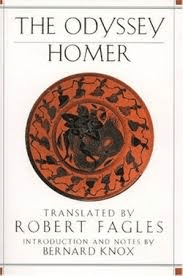
So we can take “andra polutropon” to mean “man of twists and turns” (that’s how Robert Fagles sees it in my favorite Odyssey translation). I prefer “man of many tropes.” And there’s a lot of things that can mean. The man who tells many common stories. The man who undergoes many common experiences. Pushing it a little further though,. I’d say “the man who is many stories.” The man whose existence is storytelling. So what the muse is asked to sing of is a man who does not have one version, not one identity, not one core self – it’s a story being sung that does not have one “canonical version,” but “many” – it’s poly-troped – and actually therein lies its strength. Odysseus himself tells and retells strategically throughout – lying about himself every chance he can get. He has no “one story,” and that’s his strength. He knew acutely “the danger of a single story.” Don’t tell Elon – he won’t like that connection either.
We can contrast “Odysseus Polutropos” with the story’s most notorious big-bad – the Cyclops. Where Odysseus tells many stories, has many versions of himself, is many stories, the Cyclops is the opposite of that. He has one eye, so he has literally no perspective – he’s not very good at talking to others, isn’t civilized, does not follow Xenia (the film’s oft-referenced “\law of Zeus”), and he thinks he knows everything there is to know. And how does Odysseus outsmart him? In the Homeric manuscript, there are two notable moments, neither of which appears directly in Nolan’s movie (because Nolan plays with the story for us – see that?).
And this story is in 3 frames. “Homer” is telling us the story that Odysseus is telling the Phaeacians (or in Nolan’s version, Calypso) about the story he told the Cyclops. Every level introduces the potential for in Mos Def’s memorable phrase – “intelligent embellishment.” Troping. Many tropes. Or as Henry Louis Gates calls it in The Signifying Monkey, “trope a dope.” The Cyclops is not ready, and gets knocked out.
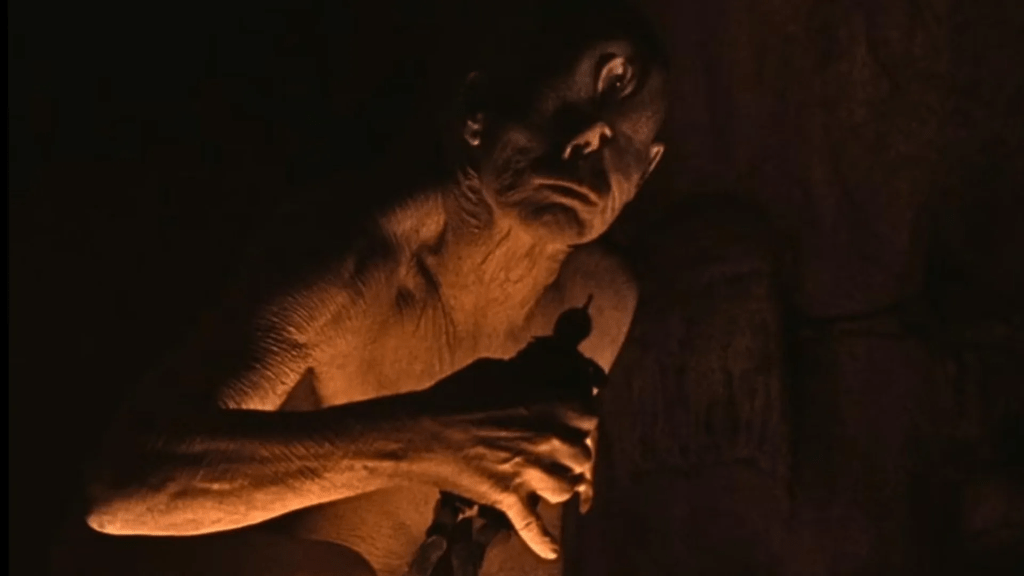
What story does the bard tell us that Odysseus told Calypso that he told the Cyclops? Odysseus tells the Cyclops his name is ‘No Man.” This is a pun in Greek – “Outis” – no one – is close to “Odysseus.” In fact one way people sometimes read “Odysseus” is “outis-zeus” – nobody-Zeus. Someone who is both no one and the king of the Gods. Someone whose strength and notoriety comes from his multiplicity and anonymity. Essentially Odysseus gives the Cyclops a composed-in-performance story about himself, an just like the bard entertains the suitors in the hall at the start of the movie, Odysseus entertains the Cyclops (and gets him drunk) with his story. When he goes to sleep, he stabs him in his one good eye, temporarily blinding him Odysseus and his men consequently outsmart the Cyclops by to grabbing hold of the underbelly his herd of sheep, and sneak out of the cave, since he can’t tell the difference (echoes of the Jacob and Esau story, and which plays on writing and speaking and blindness and sheep wool too).
That’s not quite how the episode goes in Nolan’s movie – he tells his own version. If you can’t tell yet, that’s very Odysseian – to tell your own version, rather than cling obsessively or literally to the original. Nolan’s twist on this story makes for something more plausible on the screen: the men place leaves on their backs so they feel like sheep as they escape. And Odysseus never speaks to the Cyclops here either.
What both versions have in common is Odysseus taking advantage of the Cyclops’ inability to comprehend poetry, to think figuratively. For Homer’s Odyssey, the Cyclops doesn’t read the pun, doesn’t know how to, because his social life hasn’t developed that for him. He’s be a terrible bard – he misses “outis” vs. “Odysseus” – that it’s not literally ‘no one,” but someone whose name sounds like “no one..” And for Nolan’s version, the Cyclops misunderstands the difference between literal and metaphorical sheep. He mistakes a man dressed as a sheep for a sheep itself. In both cases, the cleverness turns on the literal vs the figurative. The Cyclops is not a good listener. He thinks things are one way – the way he’s used to them – and when they change, he can’t handle it, and futilely throws rocks as his would-be prey escapes.
Sound familiar? Elon Musk has one vision of what the Odyssey should be, of “the real Odyssey.” And from that view, Nolan is desecrating it by making not-racially-expected casting decisions. Musk and everyone who agrees with him can’t see the multiplicity and play that define the text. When it’s played with, they panic and try to block the door.
The Cyclops episode can also be read as a metaphor for group composition in performance itself. Who did this? “No one.” There is not one single man who made the story you’ve been told, but a group of people working in concert. The Cyclops, and Musk, ask “what is that story? Who wrote it?” Odysseus, and the bards, and Nolan, aren’t playing that game. They are telling a new story that resonates and a clever listener can actually track that and enjoy it. X/Twitter has a lot in common with the Cyclops and his antisocial way of life. The Cyclops is a troll! Literally and figuratively – the person who misunderstands and reacts hostily to that misunderstanding. Odysseus is a master storyteller, and also a metaphor for that human collectively created multiplicity itself. This story is the tradition telling a story about its strategic advantages.
You can spin a similar tale about the end of the epic/movie – the suitors are constantly beguiled by literal meanings whose metaphorical values are in plain sight if they would but think about it. This brings about their downfall. Penelope weaving and unweaving the shroud being a key example. She knows how to tell stories – how to weave – they don’t – they only know how to think about the end result. She uses their ignorance of weaving – of storytelling – to exploit that process to her own advantage. All the sympathetic characters in Homer’s text do something like this. They are all oral poets hiding in plain sight in what to us is a written text. When Odysseus strings the bow, he tells the story none of them can with their own fixed-narrative mindset. The movie plays on this cleverly, I think, by making its stringing musical.
Conclusion
So – how is this “desecration?” How is Musk right in spite of himself? The Odyssey began as pop culture – as a 8th century BCE graphic novel, podcast, television series, however you want to think about it – generated by working class performers. It was not “sacred” – but it got sacralized, first for the Greeks and more significantly for us, for 19th century British prep schoolboys and their 20th century wannabe inheritors. Parts of the 19th century British intellectual industry were in the market for ideological bases of empire – stories they wanted to tell themselves about greatness and ancestry. As has been well documented by classicists now, they saw Romans and Greeks as well suited for this aim. They built an idea of “western civilization’ as somehow continuous and sacred, partially as a rationalization for empire. That meant, among other things, a vision of Homer as a genius writer, who told serious, important stories. And they built a contrast with Homer, Shakespeare (who they did something similar to) et al on the one hand, and the “primitive” shamans and illiterate rituals of the people whose lands they sought to conquer and justify conquering. As has been demonstrated, they literally (and figuratively) “whitened” the classics (white marble that had originally been painted was falsely seen to have been “pure” and white in its original incarnations). The 19th century sacralized a “western canon” and the Odyssey was placed at its core. Interestingly to me, Virgil had done the same thing in Roman times, writing his own Aeneid (this one is written from start to finish) embedding Roman imperial propaganda in several of its sequences. What doesn’t work about the Aeneid, to me, is how literal it is, how un-playful and literary its main characters behave.
Pop culture interpretations of Homer – among which Joyce’s Ulysses (obscene!), O Brother Where Art Thou? (self-indulgent!), graphic novels assigned to freshmen in high school (the horror of lowered standards!). All get this same pushback from supposedly serious folks like Elon Musk. I’m not saying Nolan’s Odyssey is the best movie ever, but it does a pretty good job using the sorts of resources our culture uses to tell these kinds of stories about itself – special effects (but apparently not CGI), celebrity actors, huge screens – they’re not doing anything massively different than farmers after work 3000 years ago were doing in their one spaces, to tell their own stories. Critics of these new versions bellow out like the Cyclopes they really are – but, worse than the Cyclops himself, they think they’re making Serious Academic points. He’s a boor, but he doesn’t aspire to anything more. As for our critics though – they’re not academic, they’re just acting like their version of the academics they think agree with them (though they don’t usually). Because all these re-tellings of the Odyssey are all “desecrating” something – a vision of our culture that rests on self-serving xenophobic myths about our origins. And for Elon Musk, who actually does believe that white people, especially South African white people, have been the victim of discrimination and “anti-white racism,” this is triggering.
But again, rather than dismiss that reaction as uneducated and disproportionate, let’s think about what it means. During his debate with William F Buckley (another era’s Elon Musk, in some ways), James Baldwin tells the story of watching westerns with Gary Cooper, and seeing him kill the Indians, as a child, and then realizing “that the Indians were you.” I think Musk (and others) are experiencing something analogous here: they see Matt Damon stab the Cyclops, decimate the suitors, and they cheer, and then they realize – the Cyclops, the suitors, are them. And it comes as a great shock. Where do you go from there? You could ask why – you could “consider multiple perspectives,” even try to understand DEI (one of Musk’s other targets in his other Odyssey tweets)… or you could double down, hurling Tweets, eating sheep, and continuing to live an existence you think is “the best the world as ever known” but is really one-eyed boorishness of a cave-dwelling ogre.


