
[This post is part 7 of a series on teaching the Kendrick/Drake Beef – click here for part 6 –“Like That – The Beef Starts in Earnest””]
“First Person Shooter” – Drake featuring J Cole – 10/24/23
“Like That” – Metro Boomin featuring Future and Kendrick Lamar – 3/26/24
“7 Minute Drill” – J Cole – 4/5/24 ← WE’RE HERE
“Push Ups” – Drake – 4/19/24
“Taylor Made Freestyle” – Drake featuring AI Tupac/AI Snoop Dogg – 4/19/24
“Euphoria” – Kendrick Lamar – 4/30/24
“6:16 in LA” – Kendrick Lamar – 5/3/24
“Buried Alive Interlude Pt 2” – 5/3/24
“Family Matters” – Drake – 5/3/24
“Meet the Grahams” – Kendrick Lamar – 5/3/24
“Not Like Us” – Kendrick Lamar – 5/4/24
“The Heart Part 6” – Drake 5/5/24
This post isn’t really about “teaching the beef” because I never brought this song into the classroom. I imagine back in 2024 when I was going through it in real time with T and other students, it came up, but now that I think about it, this was going down during spring break, and it’s possible that by the time we got back to class this song was already gone. Because J Cole in fact chose to bow out. You can tell from the lyrics themselves that his heart wasn’t in it, and the fact that it was originally on an album called Might Delete Later – well, he carried through on that.
Apparently the title “7 Minute Drill” refers to J Cole’s discipline of writing tracks he gives himself only seven minutes to complete. Which to me is interesting given the whole oral-poetic idea that a time limit, performance under pressure in general is what makes it work. Overall, I think what he does here is publicly contemplate whether he wants to really go all-in, throwing some pretty light-weight test shots at Kendrick – things he could take back if he wanted to, to engage and even possibly attempt to de-escalate (if he was trying to do that, it didn’t work, obviously).
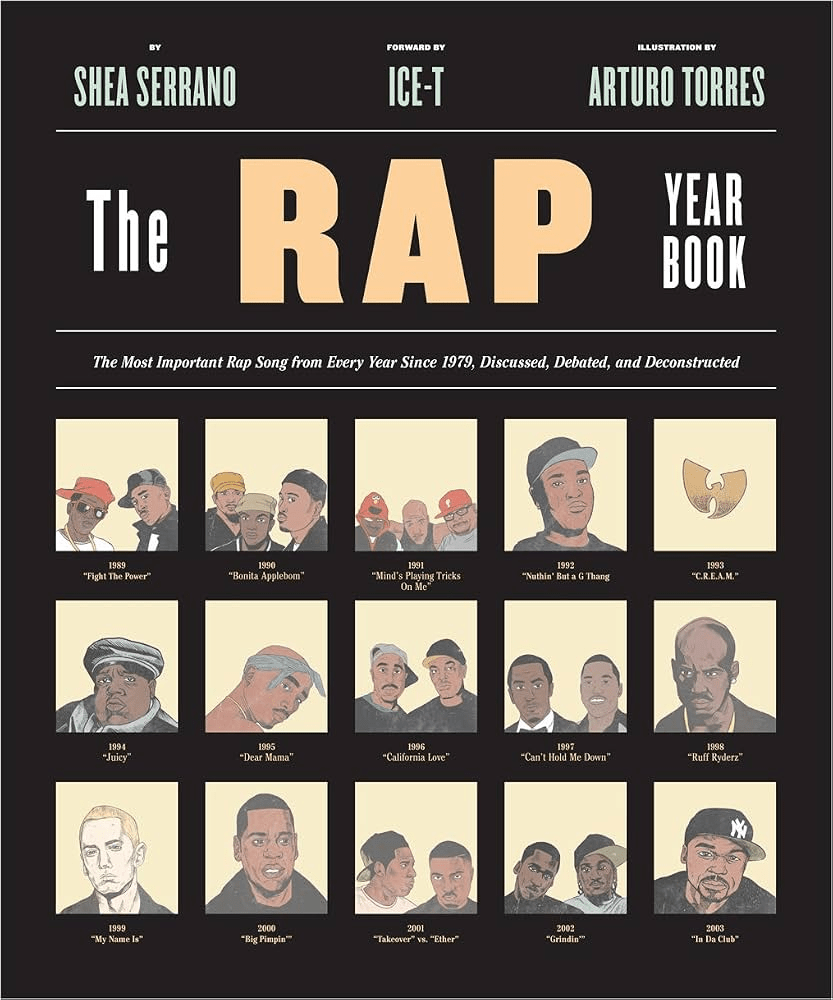
Genius points out that J Cole interpolated words from Jay-Z’s “Takeover,” one of his responses to Nas in their 2001 beef, about which Shea Serrano says in The Rap Yearbook (2015) that there would never be a bigger hip-hop dispute. I’ve wondered whether he’d defend that – probably not, given the tone of the book – he’d probably just say he is glad he was wrong, especially considering how pro-Kendrick he is in the book’s final pages.
For what it’s worth, here are some thoughts I have about this song, stepping through the lyrics like I’ve done in other posts. After song ad-libs, the song starts with a chorus that repeats later:
Light work like it’s PWC
It’s a cold world, keep the heat under your seat
I got a phone call, they say that somebody dissin’
You want some attention, it come with extensions
My dog like, “Say the word, ” he on bullshit, he itchin’
Done put in so much work in these streets, he got pension
I told him chill out, how I look havin’ henchman?
If shots get to poppin’, I’m the one doin’ the clenchin’
Some of the first part has some clever punchlines – referring to Kendrick’s verse he says it was “Light work like it’s PWC” – at first I thought he might be saying “PVC” – lightweight plastic – but it’s apparently the Public Works Commission in Cole’s hometown, the idea being sometimes they replace lightbulbs- light work. The sense being, how many overrated rappers does it take to change a lightbulb? And that the verse itself is lightweight. A decent pun and example of the kind of retractable attack Cole seems to focus on here.
The overall claim seems to be that Kendrick is trying too hard – working to get a pension, and also that it’s sort of conservative, predictable work, the kind of job that still confers a traditional pension (like the PWC I guess). And finishing this passage with the idea that if something real is going to be said (“shots get to poppin’) he’s the one that will actually pull the trigger.
These lines draw a good contrast:
If shots get to poppin’, I’m the one doin’ the clenchin’
I came up in the ‘Ville, so I’m good when it’s tension
He still doin’ shows, but fell off like the Simpsons
Fayetteville NC, J Cole’s home town is ““the ville,” – from what the internet says a violent and crime-ridden city he’s able to grab the rhyme from “Clenchin’”, and then make a decent half-rhyme contrast with “fell off like the Simpsons,’ both building in an allusion to his own forthcoming (eventually, in 2026) album The Fall-off, and also managed to acknowledge that perhaps Kendrick, like the Simpsons, once had some real quality jokes, but had since lost its street credibility.
J Cole, from what I know of him (which isn’t that much) works with punch-lines similar to Drake’s, and the 7 minute thing probably makes that tendency more pronounced. There’s nothing wrong with punch-lines and in fact, oral poetic analysis of Homer reveals the same thing. Lines tend to fall into two halves – less governed by rhyme and more rhythm but the underlining idea is the same. You introduce some new content in half the line, and lean harder on something formulaic in the second. You can see that in these lines too – usually it’s specific thought followed by more general rhyming allusion or concept. It’s really interesting to me that if you look at this whole song, you’ll see lines breaking into two halves. In Homer or other epic verse this is called the caesura, and serves the same function often – it’s a brief pause (not a whole beat, just a sort of emphasis shift) where the line pivots from new content to old.
For example here’s the first line of the Iliad:
μῆνιν ἄειδε θεὰ Πηληϊάδεω Ἀχιλῆος
Singer about anger ,Goddess, the anger of Achilles, the son of Peleus.
Usually the caesura would be drawn after “θεὰ” (goddess):
μῆνιν ἄειδε θεὰ – literally, “about anger, sing, Goddess”
Πηληϊάδεω Ἀχιλῆος – “of the son of Peleus, Achilles”
The second half is a “punchline” in the sense of being an epithet – “Achilles son of Peleus.” What Milman Perry argues, very extensively, about Homer, is that it’s full of these epithets. The idea is that they are things the poet already has memorized, and can throw in, picking the exact number of syllables needed for the rhythm. They might pick “Achilles son of Peleus” or “swift footed Achilles” or “godlike Achilles” or “Achilles best of the Achaeans.’ And Perry’s argument is this is mostly on metrical, not meaning-based grounds. They’re punch lines. They let the line finish, while the poet thinks about what to say next, since the recitation of the epithet is so fixed in their minds it doesn’t take as much mind.
So when J Cole performs a “seven minute drill” he ends up leaning on formulae for the same reason the original Homeric bards did: to give themselves space to think without having to pause. Look here:
He still doin’ shows, but fell off like the Simpsons
“Like the Simpsons” is a rhyme J Cole can relatively easily ad-lib. He knows it will land, because The Simpsons is a popular show. It’s a stock rhyme – the kind of thing he knows how to throw in whenever he needs it. Especially if he’s doing a “seven minute drill.”
The next part of the song explores and evaluates Kendrick Lamar’s albums’ history, I think.
Your first shit was classic, your last shit was tragic
Your second shit put n****s to sleep, but they gassed it
Your third shit was massive and that was your prime
I was trailin’ right behind and I just now hit mine
“Your first shit” I think is Good Kid mAAD City – J Cole concedes it’s a classic because it would be really hard not to – it’s been on the Billboard Top 200 for over 700 weeks. This concession helps Cole some credibility with the second half of the rhyming line “last shit,” in 2024, refers to Kendrick’s 2022 effort Mr. Morale and the Big Steppers, which in fact, is tragic in the sense that it explores family and social tragedy; likely Cole means something more like “not a good album.”
“Your second shit put n****s to sleep but they gassed it” I think is saying that Kendrick’s 2015 To Pimp a Butterfly was overrated. That’s a relatively “easy” accusation to make, as the album focuses much less on radio hits (though it had several), and much more on something deeper and yes, more important, and also because it is very, very highly rated (96 on Metacritic). Calling things “overrated” is always rhetorically useful but difficult to argue. The central point seems to be that some kind of herd mentality took over, but none of that herd has made a good argument. Cole’s argument seems to me that it puts people “to sleep” – that it’s too mellow, maybe, not enough bangers, which is a cogent claim, but again, pretty tame as an attack – probably intentionally so.
“Your third shit was massive and that was your prime” is about DAMN (2017), which it seems J Cole also likes more (though it’s actually my least favorite of Kendrick’s albums for whatever reason) – and it did, you know, win the Pulitzer Prize in Music. Again, a concession, sort of – when he says “was” he cleverly implies that Kendrick isn’t there anymore. “…and I just now hit mine” (his prime) is sort of an interesting thing to say in a diss track, sounds a little self-promoting . Notice he’s laced the idea of “his prime” and “The Fall-Off” into the verse, highlighting a second purpose here: self-promotion – back in “First-Person Shooter” he strikes a similar tone – “I’m namin’ the album The Fall Off/It’s pretty ironic ’cause it ain’t no fall off for me.”
Now I’m front of the line with a comfortable lead
How ironic, soon as I got it, now he want somethin’ with me
Well, he caught me at the perfect time, jump up and see
Boy, I got here off of bars, not no controversy
Funny thing about it, bitch, I don’t even want the prestige
Fuck the Grammys ’cause them crackers ain’t never done nothin’ for me, ho
This actually expands on some of the arguments Drake made back on “First Person Shooter,” especially the position about the Grammys. Noting that he’s big because of “the bars” (the music itself) not “controversy” – to be fair, Kendrick is not afraid of strategic controversy, but really, what would it mean to say Kendrick doesn’t have bars or hasn’t gained at least some of his popularity because of legit talent? It feels like a pretty over-the-top claim, but at the same time, relatively mild in tone. The most interesting line here, I think, is “Fuck the Grammys ’cause them crackers ain’t never done nothin’ for me, ho”, which is a more articulated version fo Drake’s “I use a Grammy as a door stop,” and puts it into a racial context. “Those crackers” being the rich, out of touch white people that do govern a lot of the award structures and voting. Which undercuts some of Kendrick’s “critical acclaim,” contrasting interestingly with the earlier “N*** gassed it.” He seems dismissive of the idea that white people and Black people (though N***s here isn’t so racially tagged really) have both, for their own reasons, decided to celebrate Kendrick Lamar – by questioning both of their motives.
Slugs took my n****’s soul, drugs took another one
The rap beef ain’t realer than the shit I seen in Cumberland
He averagin’ one hard verse like every thirty months or somethin’
If he wasn’t dissin’, then we wouldn’t be discussin’ him
Lord, don’t make me have to smoke this n**** ’cause I fuck with him
But push come to shove, on this mic, I will humble him
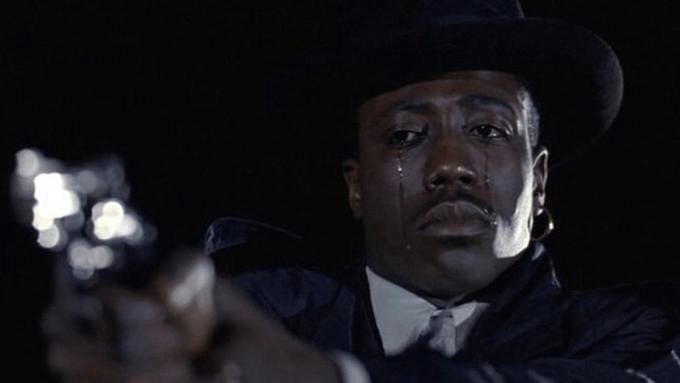
I’m Nino with this thing, this that New Jack City meme
Yeah, I’m aimin’ at G-Money, cryin’ tears before I bust at him
Largely repeats earlier content. J Cole has been through harder circumstances, and Kendrick just craves controversy and PR. But he also seems to be saying “this doesn’t have to be that serious either way” – “the rap beef ain’t realer than the shit I seen..” And then “Lord, don’t make me have to smoke this n**** ’cause I fuck with him“ shows some more real ambivalence. He’s saying, look, Kendrick’s not so bad, I’m not sure I really want to do this but if I have to, I will, and the film references that follow attempt to square a circle, alleging that he’s going to feel bad while he’s doing what he has to do. If he has to “push come to shove I will humble him” also obliquely refers to Kendrick’s Humble, the first single off of DAMN. “I’m Nino with this thing” is a pretty solid set-piece two lines (also something that happens in Homer), referring ultimately to this image of Wesley Snipes (Wesley Snipes is himself alluded to on Kendrick’s “Wesley’s Theory,” the first track of To Pimp a Butterfly) – the sense being, just because Kendrick is his friend doesn’t mean he won’t come after him if he needs to (even if he has to cry through it).
After the chorus repeats we get another verse that doesn’t go anywhere that new – though he does interlace some clever allusions. One that catches my eye is:
“Your arms might be too short to box with the god” – this is one of those cool hip-hop signifying chains that I’m always excited to learn about. What I saw is Mos Def and Talib Kweli’s “Thieves in the Night” – which title itself alludes both to Toni Morrisons’ final paragraphs in The Bluest Eye and from there to the Bible:
Survival tactics means, busting gats to prove you hard
Your firearms are too short to box with God
Without faith, all of that is illusionary
Raise my son, no vindication of manhood necessary
But when I looked up the reference on genius.com, it directed me instead to James Wheldon Johnson’s The Autobiography of an Ex-Colored Man. Something I love about this is it doesn’t need to be either/or. J Cole in fact may have been referring to some other rapper that used this line in some other context. But the point is, he’s calling on the tradition. In the Talib Kweli verse, I think part of the sense is to question who rappers fighting with each other really serves. And so maybe Cole is again backing off of his posture while he’s taking it.
I’m hesitant, I love my brother, but I’m not gonna lie
I’m powered up for real, that shit would feel like swattin’ a fly
Four albums in twelve years, n*** I can divide
I think this echoes something I remember Jay-Z doing vs. Nas – math. Suggesting Kendrick isn’t prolific enough, doesn’t have that timing, would never do a “seven minute drill” because he mulls over his words too much.
“This is merely a warning shot to back n**** down” and also “I’m fully loaded, n****, I can drop two classics right now” but seem more de-escalatory than anything else. And the final two lines repeat both purposes we saw earlier: “Hah, let me chill out, man (Conductor)/The Fall Off on the way, n***” – let’s not fight, and also, look out for my album when it drops.
The Retraction
Even though this song is mild in its attacks, less than two days latter, J Cole said this on stage:
I’m so proud of that project [the album Might Delete Later] except for one part… One part of that shit makes me feel like that’s the lamest shit I ever did in my fucking life….For the first time, I was tested. Why am I tested? Because I’ve got the world, and I’ve got my n****s like ‘What are you gonna do Cole?’ … I felt conflicted because I know I don’t really feel no way, but the world want to see blood. I moved in a way that I spiritually feel bad on. I tried to jab my n*** back and keep it friendly, but at the end of the day, when I listen to it and when I see the talk, that shit don’t sit right with me with my spirit. That shit disrupts my fucking peace. So what I want to say right here tonight, is that in the midst of me doing that – trying to find a little angle and downplay this n****’s catalog and greatness – how many people here think Kendrick Lamar is one of the greatest motherfuckers to ever touch the ficking microphone? Dreamville, y’all love Kendrick Lamar? As do I. I want to come up here and publicly say that was the lamest and goofiest shit … it made me feel like 10 years ago when I was moving incorrectly. I pray that my n**** didn’t feel no way, and if he did, I got my chin out. Take your best shot and I’ll take that shit on the chin, boy. Do what you do” (emphasis added)
In a strange way as I read this, it’s genuinely moving. J Cole did something that is super-duper rare in the 2020’s – he made a mistake, out loud, and realized he did so, and apologized. In a way that really does seem sincere.
Drake, on the other hand, saw things differently – we’ll get to that next time.


