
[This post is part 8 of a series on teaching the Kendrick/Drake Beef – click here for part 7 –J Cole’s “7 Minute Drill””]
“First Person Shooter” – Drake featuring J Cole – 10/24/23
“Like That” – Metro Boomin featuring Future and Kendrick Lamar – 3/26/24
“7 Minute Drill” – J Cole – 4/5/24
“Push Ups” – Drake – 4/19/24 ← WE’RE HERE
“Taylor Made Freestyle” – Drake featuring AI Tupac/AI Snoop Dogg – 4/19/24
“Euphoria” – Kendrick Lamar – 4/30/24
“6:16 in LA” – Kendrick Lamar – 5/3/24
“Buried Alive Interlude Pt 2” – 5/3/24
“Family Matters” – Drake – 5/3/24
“Meet the Grahams” – Kendrick Lamar – 5/3/24
“Not Like Us” – Kendrick Lamar – 5/4/24
“The Heart Part 6” – Drake 5/5/24
Like I’ve said, I didn’t come into this objectively – I think Kendrick Lamar really wins this whole thing pretty handily and in a way that helps us reckon with some important truths about rhetoric, argument, ethics, culture, race and more. That’s why I wanted my students to do this project, if I’m being honest.
That said, I do think Drake does a pretty good job on “Push-Ups” refuting some of Kendrick’s arguments and reestablishing his own. Not a knock-down perfect job, but, after this song was released, l think it would have been reasonable for an observer to say that Drake had put Kendrick in a decent-sized hole, or that the thing would probably end now that both sides had had their say. Which of course was not true. As one of my most enthusiastic students of the beef – W – a white male really into a lot of more obscure hip-hop I have not heard of said “‘Push-Ups’ is a good song. Drake had a chance.”
It doesn’t sound like a lot, but I think Drake generates a decent strategy around making fun of Kendrick Lamar’s height and/or shoe size, and using that as an organizing principle for taking him down a peg in a lot of ways (beyond just the obvious shoe size connotations). Hence the cover art:
Let me try to show why I think Drake had a chance here – and as a reminder, in my teaching context, I had my students do two things – first, they rhetorically analyzed a particular song, meaning they focused on an argument about author, audience and purpose, one that delved more into technique than into whether the singer’s argument was right, or even effective. The second thing they did (after they did the rhetorical analysis) was an argumentative assessment of the whole beef, making an argument about who won, and why. In these posts, I’m blending the two, which is a bit tricky, especially as the arguments get more complex and interwoven, as they do from this point forward. I’ll try my best.
What Drake Needs to Answer
At this point in this debate/conflict is enacting, Drake has offered some arguments why he is the GOAT, all of which circle around the idea that he’s popular, best-selling, powerful and attractive to women. Kendrick Lamar has responded to this by advancing a different criterion for greatness: respect paid to tradition and culture. Those are the two sides – roughly. As I see it, there are four possible outcomes to this debate as it stands, with two scenarios favorable to each performer:
- Drake can win that popularity matters more than respecting the tradition, in which case he can then
- Win that he’s more popular, and therefore he wins
- OR Kendrick can still win that he himself more popular, and therefore he wins even with Drake’s preferred paradigm for winning
- Or – Kendrick can win that respecting the tradition matters mor ethan popularity, in which case he can then
- Win that he’s more respectful to that tradition, and therefore he wins
- OR Drake can win that he himself is more respectful to that tradition, and therefore he wins, even within Kendrick’s preferred paradigm for winning.
1A and and 2B both result in Drake wins; 1B and 2A both result in Kendrick wins. Debates like this happen all the time: both sides have a prefered way to evaluate the debate, but also have arguments that work within their opponent terms as well. In debates like this, the winner usually ends up through 1A or 2A. The reason for this is simple: each artist announced a criterion for GOATness that they probably believe they could win with. That’s why they defined GOATness the way they did. But 1B and 2B are real possibilities – essentially that’s winning on your opponents’ turf, which is harder but also more satisfying if you can pull it off.
Now all of that flattens this into a debate, which is not all it is. There are also various ways we can assess each performance as music, not only as argument. But what’s interesting to me is that the musical aspects of each song tend to work in service of the debating – form follows function here.
So given this landscape: what Drake does in “Push-Ups” is re-establish his popularity (giving him access to his most likely victory route – 1A, and denying Kendrick access to 1B) and also simultaneously attacks Kendrick’s authenticity/respect for tradition (attempting to block Kendrick from winning via 2A, or even attempting himself to win via 2B). Now, what Drake never convincingly does, I don’t think, is actually compare track 1 and track 2 – something we saw Kendrick did very clearly and efficiently in these lines in “Like That”:
D-O-T, the money, power, respect
The last one is better
Say, it’s a lot of goofies with a check
Kendrick is arguing authenticity/respect for tradition is more important than popularity and money, because it’s relatively easy to get money for the wrong reasons, and therefore popularity doesn’t prove anything. So far as I can tell, Drake just never attacks this claim. He works within the framework it proposes (that’s what 2A is), but he just keeps trying to win 1A without really winning 1 – he’s preoccupied with demonstrating his popularity but never provides a deeper criterial argument for why popularity is more important.
The closest the closest Drake comes to refusing respect as a criterion is “I use a Grammy as a doorstop” in “First Person Shooter,” which J Cole also amplifies in “7 Minute Drill” with
Funny thing about it, b****I don’t even want the prestige
Fuck the Grammys ’cause them crackers ain’t never done nothin’ for me, ho).
But even this doesn’t really answer Kendrick’s argument, it answers Drake’s misunderstood version of Kendrick’s argument. Kendrick never says he’s more critically acclaimed, or even that he wins more Grammys. Kendrick never mentions the Grammys. When he means by “respect” – which will become clearer as I go deeper into these other songs – is not how much respect he receives from outside entities (Grammys, journalists) – all that would just be another kind of popularity with a different audience (again, shades of Socrates’ argument against Euthyphro – it’s not about which group of gods do or do not support you, but something else). Instead, Kendrick focuses on how much respect he pays. That’s the fundamental realization as far as I can tell Drake does not have in him to make. And that – not to get too far ahead of myself – is exactly what Kendrick means when he describes Drake as “not like us.” Drake just does not see that virtue might be its own reward, that respect for a community is what can constitute greatness. But all that’s much later.
And this is very much the mistake Euthyphro keeps making with Socrates, who never provides a non-circular definition of “piety” that might work to show Socrates he’s really right about prosecuting his father. Kendrick did something very effective that debaters know to do: he has preemptively defined the terms of the debate and done so through a very clever and efficient motto – “the last one is better.”
One reason this may be true is that Kendrick may have established an argument Drake believes. Saying something your opponent believes and using it to win your argument is always effective, because they just don’t have the argumentative reflexes at that point. Even if they’re arguing, part of them believes you’re right, and it blunts the sting of your counterattack. Drake never says something like what Jay-Z says on his verse on Kanye’s “So Appalled” –
But would you rather be underpaid or overrated?
Moral victories is for minor league coaches
Mayte that is because at some level Kendrick seems to intuit about Drake, that’s not good enough for Drake He doesn’t just want to win, he wants to be loved, or at least be respected. I think this comes to the fore much more clearly in Kendrick’s true magnum opus here – “Euphoria,” which is coming up two songs from now.
Also, significantly, Drake seems to have lost an ally. J Cole hasn’t turned on him per se, but he seems pretty uninterested, post “7 Minute Drill,” in taking up arms alongside Drake, especially considering some of what J Cole said bears on the above – Cole’s behavior seems almost to acknowledge that respect may matter more to him than popularity, and he seems to have decided that going after Kendrick is disrespectful in a way he perhaps didn’t realize at first.
Drake’s Arguments in “Push-Ups”
This song is tough to analyze systematically because, unlike “First Person Shooter,” it’s actually pretty scattershot. He has a lot of one-liners about a lot of different targets, but not so much od a sustained argument against any of them. Still, I think it’s effective because it creates a lot of future stances he could develop – and this is something a good debater often does in what will figure to be a longer debate. Also (this is more subjective) I don’t think the song (or any of the other future Drake songs) is all that musically interesting. From here on out, each of Drake’s songs just sort of adapts a kind of all-purpose gloomy minor-key sound – what beat switches there are all remain within that. He also becomes more and more reliant on this kind of breathy but unconvincing toughness – which you can hear in this song when he says “drop drop…” Whereas I think it’s fair to say Kendrick’s sonic and musical decisions continue to add a dimension to his arguments.
Structurally, “Push-Ups” is two long verses with a chorus that repeats after each, plus an outro that’s really a mini-chorus. It starts with Drake re-establishing his superiority popularity vs. Kendrick Lamar and Future, who had attacked him about three weeks prior on “Like That?”:
I could never be nobody number-one fan
Your first number one, I had to put it in your hand
You pussies can’t get booked outside America for nan’
I’m out in Tokyo because I’m big in Japan
I’m the hitmaker y’all depend on
He seems to implicitly counter the “respect” idea with that “number-one fan” line – he’s not interested in paying respect to others, or being fans of them. Arguably, this is Drake making a claim about why popularity is more important than respect (though again, it seems to misunderstand what respect might mean- respect is more of a moral idea, fandom more about popularity still). “Your first number one I had to put it in your hand” is Drake suggesting that he’s the reason why Future first was successful on the Billboard charts, with the song “Certified Lover Boy,” which did feature Future. I’ve also wondered if Drake is partially talking about his earlier (like 2010) support for Kendrick as part of the reason Kendrick got big. Either way, Drake is establishing he’s more popular than them because it’s his participation that helps either of them achieve the popularity they have. To use a math analogy, I think Drake’s saying he’s on a higher order of magnitude – his popularity isn’t just bigger than theirs, it dominates it.
The next few lines make similar boasts – Drake is big and that’s why they are, if they are at all, even though they’re not as big as him.
How the fuck you big steppin’ with a size-seven men’s on?
Is Drake referring to Kendrick Lamar’s most recent album at the time of this release – Mr. Morale and the Big Steppers, but also assailing Kedrick’s height via his shoe-size Which does attack Kendrick for not being as “big” in another sense.

Note the height difference between Drake and Kendrick:
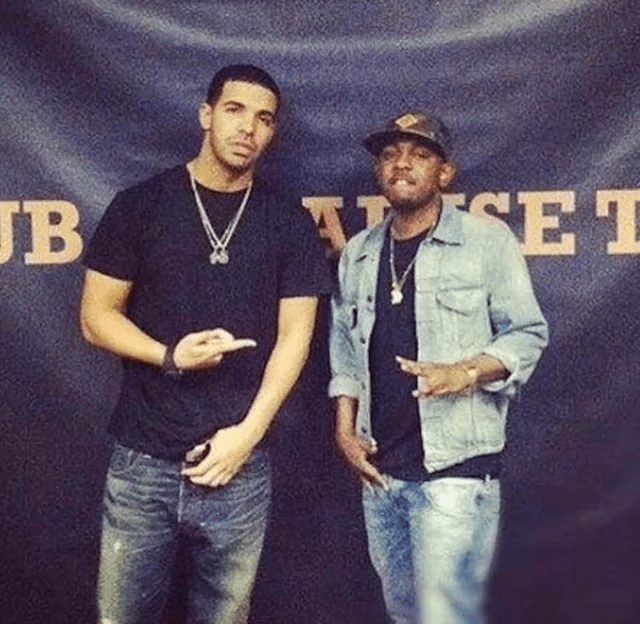
This the bark with the bite, n****, what’s up?
Might be referring to Kendrick’s old label, TDE (Top Dawg Entertainment) (see below):

Know my picture on the wall when y’all cook up
rake’s sure he’s on their minds 24/7 when they’re recording, and or doing low-status drugs. And sort of cleverly, comparing their recording to them smoking crack – highligthing their desperation and dependence.
Extortion baby, whole career, you been shook up
‘Cause Top told you, “Drop and give me fifty,” like some push-ups, huh
And here’s where Drake comes the closest to attacking Kendrick’s authenticity and respect. He’s going after Kendrick’s self-respect – “drop and give me 50” is someone demanding someone else do push-ups, like a gym teacher or a prison guard, but it’s also the fact that while Kendrick was still signed to them, TDE apparently took 50% of Kendrick’s royalties. Which means Drake’s arguing that Kendrick is beholden to his record label, not his own person. So Kendrick isn’t doing what he’s doing to respect a tradition, but because he’s enthralled to a label, stuck in a bad contract.
Your last one bricked, you really not on shit
They make excuses for you ’cause they hate to see me lit
“Your last one bricked” Is again about Mr. Morale and its relatively commercial failure – “They make excuses” goes after Kendrick’s respect from the critics, suggesting they’re not being anti-Drake, not pro-Kendrick in who’s defending him. Questioning the motives of the critical acclaim he’s received basically. The respect Kendrick receives is not deserved, not even real.
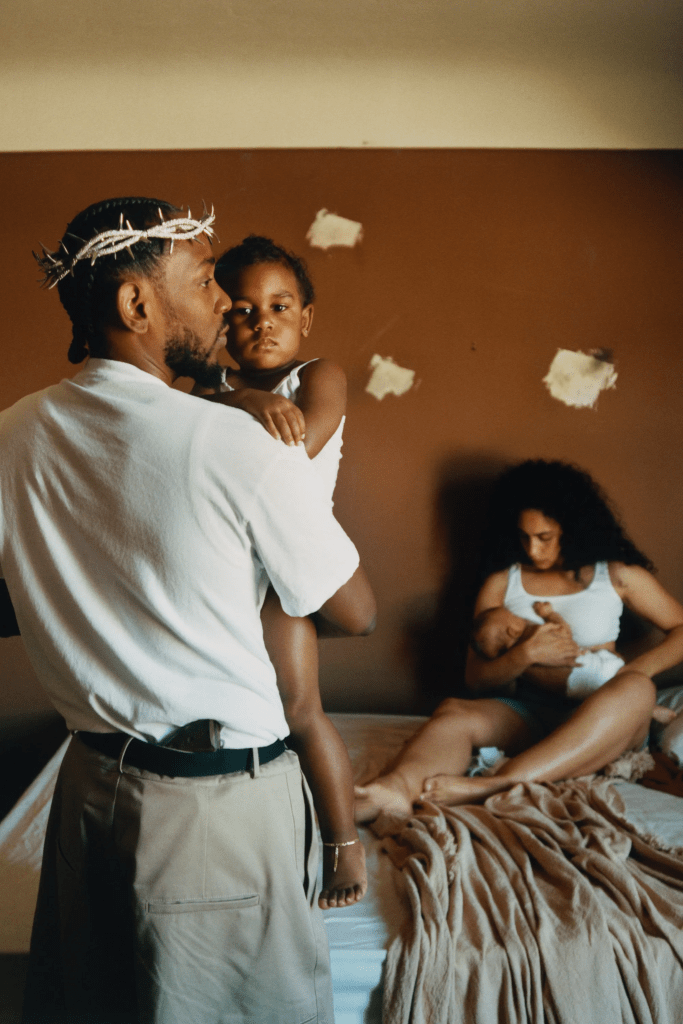
Pull your contract ’cause we gotta see the split
The way you doin’ splits, bitch, your pants might rip
Has some clever wordplay about pants splitting vs. contrast splitting, and another dig at his manhood built in there.
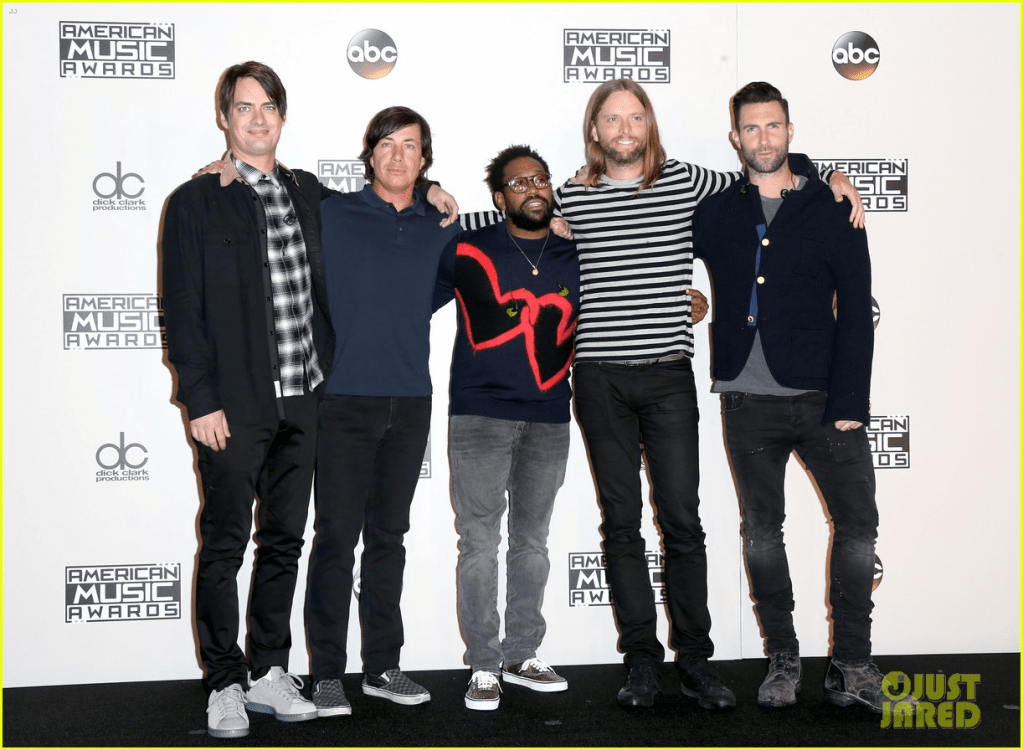
Maroon 5 need a verse, you better make it witty
Then we need a verse for the Swifties
Suggests that Kendrick isn’t as respectful to tradition as he presents, given that he’s recorded with mainstream white acts like Maroon 5 and Taylor Swift. When Drake says “for the Swifites” he notably changes his enunciation to sound like a white pop star (another version of his breathy “I”m being mean” voice). And again, notice the height difference – Kendrick is a good degress shorter than Maroon 5 and also Taylor Swift:

He then goes on to compare Kendrick unfavorably to Black artists as well:
You ain’t in no big three, SZA got you wiped down
Travis got you wiped down, Savage got you wiped down
Retracting J Cole’s earlier “big three” idea, suggesting that SZA, Travis Scott and 21 Savage are all out-performing Kendrick.



T – One of my white male students who described himself as “not that into hip-hop” actually put in a lot of work with this song (including 2 revisions of the podcast recording). Eventually, he traced through a lot of the allusions and their rhetorical effects – his central claim being, they’re all examples designed to take Kendrick down a peg for a largely Black audience, by attacking his seemingly greatest strength, which is, the credibility he has with those Black artists and their fans, as well as the skepticism they may hold about Maroon 5 and/or Taylor Swift. I thought this was a good read on his part, thinking through how examples work with audiences specifically, not just to establish “credibility” in general, which is one of the hardest moves for high school students to make, at least in my classroom.
Like your label, boy, you in a scope right now
And you gon’ feel the aftermath of what I write down
Is some clever wordplay with Interscope – Kendrick’s new record label – with “in a scope” – and Aftermath – his earlier one.

The Michaal Jackson/Prince argument continues – recall that Drake said he was “one away from Mike” and then Kendrick said “Prince outlived Mike Jack” – here’s Drake’s two part reply:
Big difference ‘tween Mike then and Mike now…
What’s a prince to a king? He a son, n****

Part 1 – sure, Michael Jackson’s present reputation isn’t great but I’m talking about the old-school Michael Jackson, who made huge hits and whom everyone loved (includong Kendrick- see “that n**** gave us Billy Jean you think he touched those kids? From “Mortal Man.” Essentially he’s arguing he wasn’t actually comparing himself to Michael Jackson more broadly, just about his hit-making potential.
Part 2 – A Prince is a son of a King (Michael Jackson as the King of Pop), meaning that Drake is greater than Kendrick. That Kendrick is in some way dependent on him, or even a little dig at Kendrick’s mom – if Drake is his father (this revisits the order-of-magnitude popularity claim).
A lot of the rest of the song is about Drake targeting specific others, as he’s worried it’s become a “20 v 1.” So he attacks Kendrick, Future, The Weeknd (Abel), Cash (the Weeknd’s manager), Rick Ross, and notably, J Cole:
I don’t care what Cole think, that Dot shit was weak as fuck
Which would seem to be a reply to J Cole’s apology and re-affirmation of Kendrick Lamar’s talent after “7 Minute Drill.”
Drake goes back to re-asserting his financial superiority:
Numbers-wise, I’m out of here, you not fuckin’ creepin’ up
Money-wise, I’m out of here, you not fuckin’ sneakin’ up
Cornball, your show money merch-money fee to us
Again, not just thsy he earns more – why Kendrick gets paid for a show is only what Drake earns selling t shirts.
Conclusions
Like I said at the outset, I don’t think Drake wins because of this song, but I do think he makes up some ground. He does a lot of work to show himself as bigger than Kendrick physically, and in terms of record sales – keeping victory route 1A open to him. He also does some things to contest 2A, at least alleging that Kendrick is more commercial and less self-sufficient than he represents himself as – which gets close, but not quite, to answering the claim Kendrick will develop more clearly over the course of the beef: that he pays respects to a tradition that Drake can’t seem to believe in.
Drake never really shows that he comprehends what Kendrick means by “respect” – he seems to respond to the issue of who Kendrick does or does not receive respect from – not to whom Kendrick gives it, and why. And on a related note, he never directly compares popularity and respect (however he might define it). He continues to win a battle he’s already winning, rather than placing that battle into the strategic significance of the larger war. He’s like a debater who isn’t impacting his arguments, or a student essayist who cites lots of evidence but misses key commentary.
On the next track – “Taylor-Made Freestyle” – Drake goes further into Kendrick’s respect argument in a different way, one that, I will argue, actually is a sort of fundamental act of hubris that massively backfires, and perhaps sets off Kendrick on a tack he might never even have taken had it not been for Drake’s flagrant disrespect for west coast tradition.


One thought on “Teaching the Beef – “Push-Ups” – Drake’s Best Response”